Seller Info

What Is Current Use in New Hampshire? A Guide to Taxes & Land Use

What Is Current Use in New Hampshire? A Plain-English Guide for Buyers and Sellers

If you've spent any time looking at land or rural properties in New Hampshire, you've probably seen the phrase “enrolled in current use” in a listing description. Maybe you nodded along. Maybe you looked it up afterward. Either way, if you're buying or selling property with acreage in the Mount Washington Valley, this is something you genuinely need to understand before you get to the closing table.

Here’s a straightforward breakdown of what current use is, how it works, and why it matters.

The Basic Idea

New Hampshire’s Current Use program (established under RSA 79-A) allows landowners to have their undeveloped land assessed at a much lower value for property tax purposes, based on what the land is actually being used for today rather than what a developer might theoretically pay for it someday.

The goal is simple: make it financially possible for farmers, foresters, and private landowners to hold onto open land without being taxed out of it. And for the most part, it works. Property taxes on current use land can be dramatically lower than on land assessed at full market value.

Who Qualifies?

To enroll in current use, a parcel generally needs to meet a minimum size threshold and fall into one of these categories:

  • Farm land actively used for agricultural production (as little as 1 acre if it meets the criteria)

  • Forest land used for timber growing and harvesting

  • Unproductive land that is neither farmable nor productive forest

  • Wetlands as defined by state standards

  • Land open to public recreational use at no charge may qualify for an additional assessment reduction

For most categories, the minimum is 10 acres, though parcels smaller than that can sometimes qualify if they are contiguous with other enrolled land or meet specific use requirements.

Landowners apply through their local assessing office by April 15th of the tax year. Once enrolled, the land stays in current use as long as it continues to meet the requirements.

What Happens When Land Is Developed or Sold Out of Current Use

This is the part that trips people up, and it’s where real estate transactions can get complicated.

When land enrolled in current use is developed, subdivided, or otherwise converted to a non-qualifying use, a Land Use Change Tax (LUCT) is triggered. The tax is generally calculated as 10% of the fair market value of the land being removed from current use at the time of the change.

That can be a meaningful number. On a parcel where $200,000 worth of land is being removed from current use, you could be looking at a $20,000 tax bill due at the time of the change. In many cases, only the portion of land being removed from current use is subject to the tax.

That liability typically falls on the owner at the time the change occurs, but it’s something buyers absolutely need to factor into their plans and negotiations.

If you're buying land with the intention of building, subdividing, or clearing it, that LUCT is a real cost that belongs in your due diligence calculation right alongside survey fees, perc tests, and road access costs.

A Few Things Buyers Should Know

When you're making an offer on current use land, ask these questions:

  • What is the current use assessment versus the full assessed value?

  • Has any portion of the parcel been released from current use recently?

  • Are there any pending changes that could trigger the LUCT?

  • Is the seller expecting you to absorb the LUCT, or will it be negotiated?

In most transactions I’ve seen, the LUCT question comes up during negotiation. Sometimes the seller handles it as part of the deal. Sometimes it shifts the purchase price. What you don’t want is to be surprised by it at closing.

A Few Things Sellers Should Know

If you're selling land enrolled in current use and the buyer intends to develop it, you'll want to be clear upfront about how the LUCT is being handled. It should be addressed in the purchase and sale agreement, not figured out after the fact.

If the land will remain in current use after the sale, the new owner generally files documentation with the town to continue the enrollment under the new ownership.

The Bigger Picture

Current use is genuinely one of the things that helps keep New Hampshire looking the way it does. A lot of the forests, farms, and open fields you drive past on Route 16 or up through Bartlett and Conway are still intact in part because their owners can afford to hold them without being taxed at the same rate as a subdivision.

For buyers who want land, it’s often a good sign. It often means the land has remained relatively undeveloped or preserved in its natural state. For buyers who want to develop, it’s simply a known cost to plan around.

Either way, now you know what it means.

If you want to dive in to ALL of the details, check out the State of NH Current Use Criteria Booklet

Disclaimer

This article is intended for general informational purposes only and should not be considered legal, tax, or surveying advice. Current Use rules, qualifications, assessments, and Land Use Change Tax calculations can vary based on the property and municipality. Buyers and sellers should consult with the local assessing office, a qualified attorney, tax professional, or land consultant regarding their specific situation.

Q1 Single Family Home Sales in Carroll County (2025 vs 2026)

More Time, Higher Prices: The Mt. Washington Valley Market a Year Later

Q1 2025 vs. Q1 2026 | Single-Family Home Sales | Carroll County, NH


Every spring I pull together a first-quarter snapshot of the single-family home market across Carroll County and drill down into a few specific towns. It's one of the most useful exercises I do all year — not because one quarter tells the whole story, but because the year-over-year comparison cuts through the noise and shows you what's actually shifting.

This year, the headline is this: the market absorbed nearly the same number of sales as Q1 2025 at meaningfully higher prices, but homes are sitting on the market noticeably longer before going under contract. Whether that's buyer hesitation, seller optimism, or simply the natural friction of a market recalibrating — probably all three — it's worth understanding before you decide to list or make an offer.


Carroll County: The Big Picture

At the county level, the story is one of stability in volume and strength in price. We went from 155 sales in Q1 2025 to 156 in Q1 2026 — essentially flat. But average selling prices climbed from $632,354 to $659,578, a gain of about 4.3%. The high end of the market also expanded dramatically: the top sale in Q1 2025 was $3,325,000; in Q1 2026 it was $4,145,000.

Metric Q1 2025 Q1 2026
Total Sales 155 156
Low Sale Price $142,500 $150,000
High Sale Price $3,325,000 $4,145,000
Avg. Sale Price $632,354 $659,578
Avg. Days on Market 62 87
Cash Sales 54 57

The one number that stands out — and that I'd encourage every seller to take seriously — is days on market. Last year buyers were moving in 62 days on average. This year it's 87. That's a 40% increase. The market hasn't stalled, but buyers are deliberating longer. If you're pricing with the expectation of a quick offer, you may need to adjust your timeline — or your price.

Cash buyers remain a significant force: 57 of 156 sales, or about 37%, closed without financing. That's consistent with last year and reflects the continuing presence of second-home and vacation property purchasers who aren't interest-rate sensitive.

The volume is nearly identical year-over-year, but the extra 25 days buyers are taking before pulling the trigger tells you something real about the psychology of this market. Sellers who respect that shift will do better than those who don't.


Conway: Steady Sales, Rising Prices

Conway — the commercial and real estate hub of the Valley — held volume nearly flat and pushed prices meaningfully higher.

Metric Q1 2025 Q1 2026
Total Sales 28 27
Low Sale Price $150,000 $150,000
High Sale Price $865,000 $1,000,000
Avg. Sale Price $484,385 $543,944
Avg. Days on Market 51 82
Cash Sales 9 8

Average selling price in Conway jumped 12.3%, from $484,385 to $543,944 — and we crossed the seven-figure threshold for the first time in Q1 data, with a $1,000,000 top sale compared to $865,000 last year. Conway has historically been the more accessible price point in the Valley relative to towns like Bartlett or Jackson, so this movement toward the upper $500s in average pricing is significant.

Days on market told an even more dramatic story: from 51 days in 2025 to 82 in 2026 — a 61% increase. If I'm listing a home in Conway right now, I'm having an honest conversation with my sellers about pricing strategy and realistic timeline expectations. A well-priced home will still sell, but "well-priced" is doing more work in this market than it was a year ago.


Bartlett: More Sales, Lower Average

Bartlett — which includes the Attitash ski area and stretches up toward Bear Notch — behaved differently from Conway, and the numbers take a little unpacking.

Metric Q1 2025 Q1 2026
Total Sales 14 18
Low Sale Price $175,000 $255,000
High Sale Price $2,145,000 $1,759,000
Avg. Sale Price $831,421 $703,772
Avg. Days on Market 62 107
Cash Sales 6 6

At first glance, a 15% drop in average selling price looks like bad news for Bartlett. But context matters. Sales volume increased from 14 to 18, and the floor of the market rose significantly — from $175,000 to $255,000. What we're seeing is a mix shift: Q1 2025 had a $2,145,000 sale that pulled the average up considerably. Q1 2026's top sale was $1,759,000. In a small-sample market like Bartlett, one or two transactions can swing the average in either direction. The volume increase and rising low end actually suggest growing activity at accessible price points.

That said, days on market in Bartlett deserve serious attention: 107 days, up from 62 a year ago. That's the longest average in this report, and it mirrors a pattern common in ski-adjacent vacation markets where buyer enthusiasm ebbs and flows with broader economic sentiment. Sellers in Bartlett need to price with discipline. The buyers are there — they're just not in a hurry.


What This Means If You're Buying or Selling

For sellers: Prices are higher across the board — that's genuinely good news. But the market is telling you something important through that days-on-market increase: buyers are not in a frenzy, and they won't overpay just because inventory is limited. The sellers who will do well are the ones who price with precision and resist the temptation to test the market at an aspirational number. Every extra week on market costs you negotiating leverage.

For buyers: You have more time to think than you did a year ago — but don't mistake a slower market for a soft one. Prices have continued to rise, and well-priced properties are still moving. The window for deliberation has widened, but it hasn't opened indefinitely. If you find the right property, make a strong offer.


Data reflects closed single-family home sales recorded in Q1 (January–March) 2025 and Q1 2026 within Carroll County, NH and the specified towns. Source: New Hampshire NEREN MLS.

How to Get Your Home Photo-Ready for Listing Day

How to Get Your Home Photo-Ready for Listing Day
If you take one thing away from this post, it should be this: your photos matter more than anything else in your listing. Most buyers aren’t reading descriptions line by line—they’re scrolling through pictures and making decisions in seconds. The photos are the first showing.

At North Conway Realty, we use professional photography on every listing (whether it’s $250,000 or $1M+). That only works in your favor if the home is truly ready before the photographer arrives.

Here’s how to make sure your home shows at its best.


1. Start with Less “Stuff”

Buyers don’t see your belongings—they see clutter.

Even small, everyday items can make a space feel busy and smaller than it is. Before photo day, remove:

  • Soap dispensers, sponges, dish towels

  • Remotes, water bottles, chargers

  • Mail, folders, paperwork

  • Laundry baskets and cleaning supplies

  • Personal items like glasses, toiletries, etc.

The goal is simple: clean, open surfaces that feel easy to maintain and move into.


2. Clear the Sightlines (This One Gets Missed a Lot)

Photographers are trying to capture the flow of your home—how rooms connect and how open it feels.

Tall or bulky items can block that:

  • Large vases or tall centerpieces

  • Big lamps or oversized lampshades

  • Tall fruit bowls or décor on kitchen islands

Swap them for lower-profile items or remove them completely. If you can see through the room, the camera can too—and that makes your home feel bigger.


3. Deal with Cords and Visual Noise

Loose cords are a small detail that creates a big distraction in photos.

  • Hide lamp cords and TV wires if possible

  • Remove extra charging cables

  • Use zip ties or tape to tidy anything that must stay

It’s not about perfection—it’s about reducing visual clutter.


4. Make Sure Every Light Works (and Matches)

Lighting has a direct impact on how your home feels in photos.

  • Replace any burned-out bulbs

  • Try to keep bulbs in the same room the same color temperature (all warm or all cool)

A mix of yellow and blue light in one photo can make a room look off, even if buyers can’t explain why.


5. Clean Up the Exterior—Especially Sightlines

First impressions still matter, even online.

  • Trim low branches blocking the front of the home

  • Clear weedy edges or overgrowth

  • Make sure the home is visible from multiple angles

You want the photographer to be able to show the full property—not fight through what’s in the way.


6. Stage Outdoor Living Spaces (Don’t Skip This)

Decks and outdoor spaces are a major selling point in our area.

  • Uncover the grill

  • Set up or uncover outdoor furniture

  • Wipe down surfaces if needed

An empty or covered deck feels unused. A set-up space tells buyers, this is where you’ll spend your summer nights.


7. Be Fully Ready Before the Photographer Arrives

This is a big one.

If you’re planning to “move a few things while the photographer is there,” you’re not ready.

Photography works best when:

  • The home is completely staged ahead of time

  • The photographer can move efficiently room to room

  • There are no interruptions or last-minute adjustments

The smoother the shoot, the better the final product.


8. Think Like a Buyer (Not a Homeowner)

Buyers are scanning quickly and forming opinions instantly.

They’re asking:

  • Does this feel clean?

  • Does it feel spacious?

  • Could I see myself here?

Everything you remove, adjust, or clean up helps answer those questions in your favor.


Professional photos are one of the most valuable assets in your entire listing. They set the tone, drive showings, and ultimately impact your final sale price.

A little preparation goes a long way. And when it’s done right, your home doesn’t just look good—it stands out.

Why Buyer “Love Letters” Can Create Fair Housing Concerns

Why Buyer “Love Letters” Can Create Fair Housing Concerns

In competitive real estate markets, buyers sometimes include a personal letter with their offer explaining why they love the home and why the seller should choose them. These are commonly called buyer “love letters.” While the intent is usually sincere, many real estate professionals discourage them because they can introduce fair housing risks for both sellers and agents.

The Fair Housing Issue

The concern stems from the federal Fair Housing Act, which prohibits housing discrimination based on protected characteristics such as:

  • Race

  • Religion

  • National origin

  • Sex

  • Disability

  • Familial status (having children)

When buyers write personal letters, they often include details about themselves that unintentionally reveal information related to these protected categories.

Examples might include statements like:

  • “Our kids will love playing in the backyard.”

  • “We’re excited to host family holidays here.”

  • “We’re looking forward to being close to our church.”

Even though these comments seem harmless, they can reveal familial status or religion, which are protected under fair housing law.

Why This Creates Risk

Once a seller sees personal information about a buyer, it becomes difficult to show that the final decision was based strictly on objective factors. If another buyer later feels they were treated unfairly, the presence of those letters can raise questions about whether protected characteristics influenced the decision.

Importantly, discrimination does not have to be intentional for a problem to arise. Fair housing cases often focus on whether protected information could have influenced the decision, even subconsciously.

For that reason, many brokers, attorneys, and industry organizations recommend keeping offers focused on objective terms rather than personal stories.

My Approach With Sellers

Because of these concerns, I do not accept or present buyer love letters to my sellers.

My role as a listing broker is to help sellers evaluate offers based on the factors that actually affect the transaction, such as:

  • Purchase price

  • Financing strength

  • Contingencies

  • Closing timeline

  • Earnest money deposit

Keeping the process focused on these objective details protects both the seller and the buyers, and it keeps the transaction aligned with fair housing guidelines.

Most sellers appreciate this approach once they understand the reasoning behind it. Personal stories may feel compelling, but a fair and legally sound process is far more important for everyone involved in the transaction.


Disclaimer

This article is intended for general informational purposes only and should not be considered legal, tax, or surveying advice. Current Use rules, qualifications, assessments, and Land Use Change Tax calculations can vary based on the property and municipality. Buyers and sellers should consult with the local assessing office, a qualified attorney, tax professional, or land consultant regarding their specific situation.

Lessons From the Deal: Why Prepared Sellers Close Faster

Real estate is full of small details and big moments. Every transaction teaches something — about negotiation, timing, contracts, people, and preparation.

In this series, Lessons From the Deal, I’m sharing real-world insights from actual transactions (with details kept private). The goal is simple: help buyers and sellers make smarter decisions by learning from situations they may never see behind the scenes.

Lessons From the Deal: Prepared Sellers Create Better Outcomes

Some homes sell because of location.
Some sell because of price.
Some sell because of features.

And some sell smoothly because the seller is exceptionally prepared.

A recent transaction reminded me how powerful preparation can be.

A Home With Great Features — and Even Better Documentation

This property had a lot going for it:

  • Solar panels supplying a significant portion of the home’s electricity

  • Thoughtful upgrades

  • Unique systems and improvements

  • Features buyers naturally had questions about

But what truly set this seller apart was what happened before the home even hit the market.

They came prepared with documentation on nearly everything:

  • Upgrade lists

  • Installation details

  • System information

  • Utility data

  • Manuals and receipts

  • Dates and service history

It wasn’t scattered. It was organized.

What Buyers Experienced

When buyers toured the home, something important happened:

Most of their questions were already answered.

And when something new came up?
We had the information within minutes.

That responsiveness created:

  • Confidence

  • Trust

  • Transparency

  • Momentum

Buyers stayed engaged because nothing felt uncertain or hidden.

The Cost of Slow Answers

Compare that to a common scenario:

A buyer asks a question.
Two days pass.
A follow-up question comes in.
Two more days pass.

Momentum fades.
Excitement cools.
Doubt creeps in.

Delays create friction — even when the answers are perfectly reasonable.

In real estate, speed and clarity matter more than most people realize.

The Practical Lesson for Sellers

Preparation reduces stress and improves outcomes.

Before listing, sellers should consider building a simple information packet that includes:

  • A list of upgrades and improvements

  • Dates of installation or renovation

  • Utility cost history

  • Manuals and warranties

  • Contractor receipts

  • Details on major systems (heating, cooling, roof, solar, water, septic)

  • HOA or association information if applicable

You don’t need perfection.
You need readiness.

Why This Matters

Prepared sellers:

  • Look transparent

  • Build buyer confidence

  • Reduce back-and-forth

  • Keep negotiations moving

  • Protect deal momentum

It’s one of the easiest ways to make your home easier to buy.

My Role in This Process

Part of my job is marketing a property.

Another key part is helping sellers anticipate questions before buyers ask them.

When we prepare early, showings go smoother, negotiations are cleaner, and deals move faster.

Well-prepared homes don’t just show better.
They transact better.

Want a great seller checklist to get ready to list your home?  Send me a message or text and I'll get it to you.  

See what has sold in any neighborhood.

See What’s Sold in Your Favorite Neighborhood — Instantly

If you’re watching the real estate market in specific North Conway area communities, the new Sold Properties Community Pages make it easier than ever to see what’s actually sold recently.

These pages consolidate ALL properties that have sold in the last 180 days and present them in a simple, map-based search format. You can visually explore exactly what’s moved, where it closed, and at what price — right in the neighborhood you’re interested in.

Whether you’re looking at:

  • Eidelweiss

  • Chocorua Ski & Beach Club

  • Birch Hill

  • Christmas Mountain

  • …or any other community around the Mount Washington Valley

the interactive map helps you see the data in context. No scrolling through long lists or scrolling through old sales — everything recent and relevant is right there.

Here’s an example of a community page:
https://northconwayrealty.com/listings/saved-search/990910/

Want a Page for a Different Neighborhood?

If you don’t see the area you’re focused on yet, let me know. I’ll build a custom sold-property search page for that neighborhood right away — so you can track recent sales without any extra friction.

These pages are designed to give you clarity and confidence in the market. Let me know what area you want next.

New FINCEN Rule for Real Estate (2026): What Buyers, Sellers & Investors Need to Know

What Buyers and Sellers Need to Know About the New FINCEN Real Estate Rule (Effective March 1, 2026)

Starting March 1, 2026, a new federal rule from the Financial Crimes Enforcement Network (FINCEN) will impact certain residential real estate transactions across the country.

If you’ve heard something about “new reporting requirements” or “title companies mailing ownership verification letters,” this is likely what people are referring to.

Here’s what it actually means — and what it doesn’t.


Why This Rule Exists

The new rule is part of a broader federal effort to prevent money laundering in U.S. real estate.

Historically, someone could purchase residential property through an LLC, corporation, or certain types of trusts — often in all-cash transactions — without publicly identifying the real person behind that entity.

FINCEN’s new Residential Real Estate Reporting Rule is designed to increase transparency by identifying the true beneficial owners behind those entity purchases.

In short:
It’s about tracking who is really buying property when it’s not an individual person.


What Transactions Are Affected?

This rule does not apply to every transaction.

It generally applies when all three of the following are true:

  1. The property is residential (1–4 family homes, condos, etc.)

  2. The purchase is non-financed (no traditional bank mortgage involved)

  3. The buyer is a legal entity or certain types of trusts (LLC, corporation, partnership, etc.)

If someone is buying a home in their personal name — even with cash — the rule typically does not apply.

If someone is getting a mortgage through a traditional lender, the rule also generally does not apply because banks already have federal reporting requirements.


Who Has to File the Report?

In most cases, the responsibility falls on the settlement agent or title company — not the real estate agent.

There is a “cascade” system built into the rule, meaning:

  • If there is a settlement agent, they report.

  • If not, it may fall to a title company, escrow agent, or closing attorney.

Real estate agents are not the ones filing the report — but we will likely need to make sure our clients understand the requirements so closing isn’t delayed.


What Information Is Required?

The report will include:

  • The legal name of the entity purchasing the property

  • Information about the beneficial owners (the real people behind the entity)

  • Basic transaction details (price, address, date, etc.)

That may include:

  • Name

  • Date of birth

  • Address

  • Government-issued identification number

For investors who frequently buy through LLCs, this will be the biggest operational change.


What About the “Mailing Requirement” Rumor?

Some people have heard that title companies now have to “physically mail something” to verify ownership.

As of now, there is no broad new national rule specifically requiring physical mail verification for standard land sales.

What is happening, however, is:

  • Title companies are tightening identity verification procedures.

  • Some underwriters may implement mailing verification as an internal anti-fraud measure.

  • Wire fraud prevention practices continue to expand.

That’s separate from the FINCEN reporting rule itself.


What This Means for Buyers

If you’re purchasing through an LLC or trust and paying cash:

  • Expect to provide additional personal documentation.

  • Plan for slightly more paperwork before closing.

  • Don’t wait until the last minute to gather ownership information.

If you’re buying in your personal name with financing, this likely won’t affect you.


What This Means for Sellers

For sellers, there is very little direct impact.

The main consideration is timing.
If a buyer purchasing through an entity fails to provide required information, it could delay closing.

Otherwise, most sellers won’t notice a significant difference.


What This Means for Agents

For agents, this is mostly about awareness and education.

  • Investor clients need to know about this early.

  • Contracts and timelines may need slight adjustments.

  • Communication with the title company becomes even more important.

This rule does not create new federal filing obligations for Realtors themselves — but we should understand it well enough to guide clients through it.


Effective Date

The FINCEN Residential Real Estate Reporting Rule takes effect March 1, 2026.

It applies nationwide — this is a federal rule, not a New Hampshire-specific law.

For most traditional homebuyers and sellers, this will feel like a non-event.

For cash buyers using LLCs or trusts, it introduces more transparency and documentation — but nothing overly complicated if you’re prepared.

As always, the key is simple:

Know the rules early.
Communicate clearly.
Avoid last-minute surprises.

If you’re planning to buy or sell property and have questions about how this might affect your transaction, feel free to reach out. I’m happy to walk you through it.

The 7 Things That Matter Most When Selling Your Home in North Conway and the MWV

Thinking About Selling in the Mount Washington Valley? Here’s What Actually Matters.

If you’re considering selling your home in North Conway, Bartlett, Jackson, Madison, or the surrounding Valley, you’re not just putting a property on the market.

You’re making a financial decision that deserves strategy.

Over the years, many of our sellers have described their experience in similar ways. Instead of telling you what matters most, I’ll let some of them help explain it.

(You can read all of our 5-star reviews here - Zillow | Google)


1. Pricing Is Strategy — Not a Guess

One seller shared:

“He recommended listing our property higher than we initially expected, and it still sold over asking.”

Another said:

“His thoughtful pricing and negotiation strategy led to a highly successful outcome.”

Pricing isn’t about picking a number that “sounds right.”
It’s about understanding:

  • Current sold data (not just active listings)

  • Buyer psychology

  • Inventory timing

  • Leverage

The goal is not simply to get an offer.
The goal is to create positioning that maximizes your net.


2. Presentation Impacts Perception — And Price

Buyers see your home online first. The first impression matters more than ever.

One client wrote:

“He produced beautifully crafted listing materials, including high-resolution photography, professional-grade video walkthroughs, and impressive drone footage that showcased the property’s full potential.”

Another said:

“The presentation he and his photographer created was even better than our Airbnb listing.”

Marketing isn’t just about exposure. It’s about elevation.

Strong visuals:

  • Increase showing requests

  • Build emotional connection

  • Justify value

  • Separate your home from the competition

In a market like the Mount Washington Valley, standing out is not optional.


3. Negotiation Is Where Equity Is Protected

Marketing brings the buyer.
Negotiation protects your money.

Several sellers specifically mentioned this:

“Dave has great negotiation skills, and his advice was on point.”

“He handled the negotiating effectively and the process went very smoothly.”

“He negotiated very well on our sale to get us the best offer possible and quick closing.”

There are multiple negotiation moments in every transaction:

  • Initial offer

  • Inspection responses

  • Appraisal challenges

  • Repair credits

  • Timeline flexibility

Strategic, calm negotiation can be the difference between a deal that works and one that falls apart — or one that quietly costs you money.


4. A Smooth Sale Is Built Behind the Scenes

Many clients describe the process the same way:

“He made the sale of our home effortless and stress free.”

“Communication was excellent! He was with us every step of the way.”

“He kept us informed at every stage, proactively addressed potential issues, and guided us with confidence and clarity.”

Every closing looks smooth in a photo.

But what you don’t see are:

  • Title issues being resolved

  • Challenging negotiations being handled

  • Contract details being explained clearly

  • Inspection concerns being managed

Clear communication and proactive problem-solving create a calm experience — and that’s not accidental.


5. Local Knowledge Isn’t a Bonus — It’s Essential

The Mount Washington Valley is not a generic market.

One client put it this way:

“His knowledge and expertise is unmatched in the Mount Washington Valley.”

Another shared:

“He is very tuned in to the market and we got in on the property as it was going on the market.”

And another:

“He keeps his finger on the pulse of what is going on in the real estate market.”

North Conway behaves differently than Bartlett.
Jackson behaves differently than Madison.
Condo markets behave differently than single-family homes.

Understanding those nuances helps determine:

  • When to list

  • How to price

  • What buyers expect

  • Where leverage exists


6. Integrity and Long-Term Relationships Matter

Real estate isn’t just one transaction. It’s often years — even decades — of trust.

Several clients have worked together repeatedly:

“Dave has been my go-to real estate professional for over 20 years.”

“This is the second time Dave has represented me…”

“After this experience, we truly cannot imagine working with anyone else.”

Another review said something that stuck with me:

“I am confident that his clients’ interests come before his profits.”

That’s the foundation of good representation.


Final Thoughts for Sellers

Selling your home is not just about putting it on the MLS.

It’s about:

  • Strategic pricing

  • Elevated presentation

  • Thoughtful negotiation

  • Clear communication

  • Local expertise

  • Protecting your equity

If you’re considering selling in the Mount Washington Valley and want a conversation about:

  • What your home could realistically command

  • How to position it for maximum leverage

  • What buyers are doing right now

  • What strategy makes sense in today’s market

I’d be happy to talk.

And if you’d like to hear directly from past clients, you can read all of our 5-star reviews here - Zillow | Google

Online Showing Schedulers Are Convenient—But They Also Reveal More Than You Think

Online showing schedulers have become standard in real estate. Tools like ShowingTime and similar platforms make it incredibly easy for agents to book showings, coordinate availability, and avoid the endless back-and-forth of phone calls and texts. From a logistical standpoint, they’re efficient. They save time. They reduce friction. And they help listings get shown faster.
But there’s another side to this that often goes overlooked.

These platforms don’t just help agents schedule showings. In many cases, they also quietly reveal something else: demand.

And demand—or the lack of it—is one of the most powerful negotiation tools in real estate.

What Buyers’ Agents Can See

When a showing calendar is visible—even partially—to agents scheduling appointments, it can provide insight beyond just availability. It can tell a story.

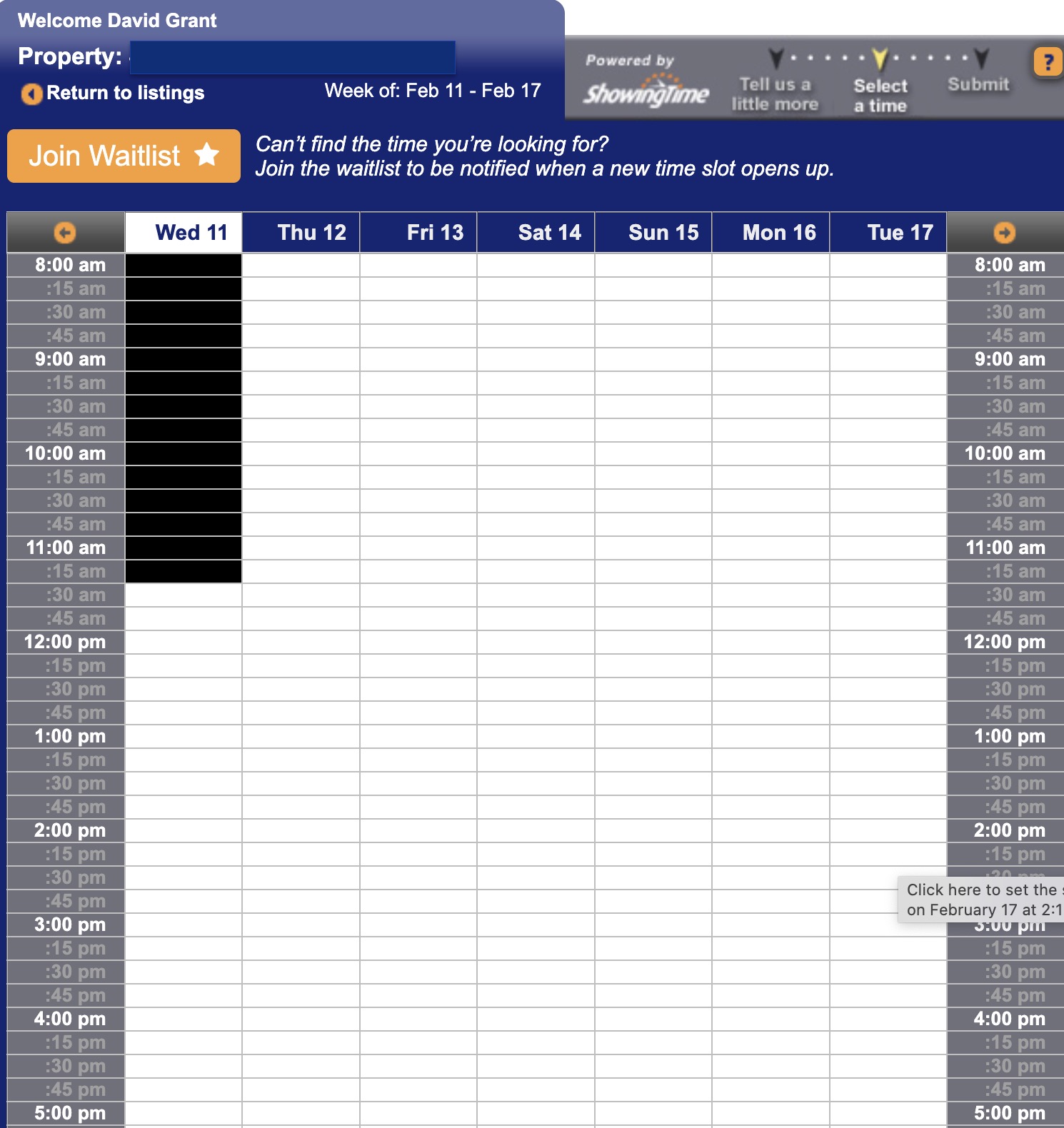
If a calendar is filled with blocked time slots, overlapping showings, and limited availability, that signals interest. It suggests competition. It creates urgency.

But when a calendar is wide open for days—or even a full week—that sends a very different message.

It suggests the property may not be seeing much activity.

And that changes how buyers and their agents approach negotiations.

A Real-World Example

I’m currently negotiating on a property for a buyer where the showing calendar is completely open for the next week. There are no showings scheduled. No blocked time slots. No indication of any upcoming activity.

As a buyer’s agent, that information is incredibly valuable.

It tells me:

  • There’s likely no immediate competition.

  • The seller may not have strong leverage at the moment.

  • There’s no urgency to rush or escalate the offer.

  • The buyer may have room to negotiate more aggressively.

This isn’t speculation. It’s simply reading the available data.

If the calendar were full, the strategy would be different. But when it’s empty, it naturally shifts the negotiating position.

Why This Matters for Sellers

Many sellers assume showing activity is private. They believe only their agent knows how much interest their property is receiving.

But in reality, online scheduling tools can indirectly share that information with every agent who attempts to schedule a showing.

That may not matter in the first few days of a listing, when activity is typically strongest. In fact, a busy calendar can actually help reinforce demand and encourage stronger offers.

But if a listing has been on the market for a few weeks and the calendar is empty, that visibility can weaken the seller’s negotiating position.

It gives buyers confidence to push harder.

It removes urgency.

And urgency is often what drives stronger offers.

Convenience vs. Strategy

There’s no question that online scheduling tools are incredibly useful. They make the process smoother for agents, sellers, and buyers alike.

But convenience doesn’t always align perfectly with strategy.

From a listing perspective, controlling the perception of demand is important. Real estate is not just about the physical property—it’s also about positioning.

Perception influences behavior.

Behavior influences offers.

A More Strategic Approach

This doesn’t mean online scheduling tools shouldn’t be used. They absolutely should. But how they’re used matters.

Some more strategic approaches include:

Using approval-based scheduling
Instead of fully open calendars, require confirmation before showings are finalized.

Creating defined showing windows
Group showings into specific time blocks rather than leaving every slot open all week.

Avoiding overly transparent availability
Limiting how much agents can see about open or unused time slots helps maintain negotiating neutrality.

Managing early momentum carefully
The first 7–14 days are critical. Strong early activity creates long-term leverage.

What This Means for Buyers and Sellers

For buyers, tools like this provide insight that can help guide negotiation strategy. It allows them to make informed decisions about timing, pricing, and leverage.

For sellers, it’s a reminder that every part of the listing process—including scheduling—plays a role in positioning the property.

Marketing isn’t just photos and pricing. It’s also about managing information.

The Bottom Line

Online showing schedulers are here to stay, and they provide real benefits. They make the showing process easier, faster, and more organized.

But they also quietly reveal signals about demand.

And in real estate, demand—or the perception of demand—is everything.

Understanding that dynamic allows agents to better protect their sellers’ negotiating position and allows buyers to make smarter decisions.

Like many tools in real estate, it’s not just about using them.

It’s about using them strategically.

How Septic System Designs Work in New Hampshire (What Every Home Buyer and Seller Should Know)


Understanding Septic Design in New Hampshire (And Why It Matters for Your Property)

If you’re buying or selling a home in New Hampshire — especially in areas like North Conway, Bartlett, Conway, or anywhere in the Mount Washington Valley — septic systems aren’t just a background detail. They’re a major part of a property’s value, safety, and ability to be used the way you want.

The video featured in this article was created by Caratunk Contractors, a New Hampshire-based excavation and septic system company with decades of experience designing and installing septic systems across the state. Their video does a great job showing what actually goes into a proper septic design — and why it matters so much for real estate.


What Is a Septic Design?

A septic design is the official engineered plan that determines how wastewater will be handled on a property. In New Hampshire, this design must meet state environmental rules and be approved before a building permit can be issued.

It’s not just about where the tank sits — it controls how many bedrooms a home can legally have, where future additions could go, and whether a property can be financed, sold, or improved without expensive surprises.


🔍 How Septic Designs Are Created

Caratunk Contractors walks through the real-world process that happens before a shovel ever goes into the ground.

1. Site Evaluation
The property is physically inspected to understand slopes, wetlands, ledge, drainage, and usable space. Not every lot can support every type of septic system, especially in mountainous or high-water-table areas like much of the Mount Washington Valley.

2. Soil Testing
Test pits are dug so the designer can evaluate how the soil absorbs water and how deep groundwater is. This is one of the biggest factors in determining what type of septic system is allowed.

3. Surveying the Property
A topographical survey is used to map elevations, boundaries, and features. This ensures the septic design will work with the natural layout of the land instead of against it.

4. Creating the Septic Plan
Using all of that data, the designer creates a layout showing the tank, leach field, setbacks from wells and property lines, and system size. This is what determines how many bedrooms the home is approved for.

5. State Approval
The final design is submitted to the state for approval. Only after that approval is granted can the system be installed or a building permit be issued.


🏡 Why This Matters in Real Estate

This process directly affects buyers, sellers, and property values.

For Buyers
The septic design controls how the home can be used. If a house is listed as a three-bedroom but the septic is only approved for two, that can cause serious financing and resale issues. Knowing the design protects you from buying a property that doesn’t match what you think you’re getting.

For Sellers
An approved, up-to-date septic design makes a home much easier to sell. It reduces buyer fear, speeds up financing approvals, and prevents last-minute renegotiations during inspections.

For Renovations and Additions
Want to add a bedroom, finish a basement, or convert a seasonal place into a full-time home? The septic design is often the first thing that determines whether that’s possible.

Caratunk Contractors’ video does an excellent job pulling back the curtain on a process that most homeowners never see — but one that plays a huge role in property value and long-term use.  Here is a link to their website.

If you’re buying or selling a home in New Hampshire, understanding how septic designs work can save you thousands of dollars and months of frustration. And when you’re looking at properties in rural or lake-area towns around North Conway, it’s one of the smartest things you can review early.

If you ever want help tracking down a septic design, understanding what it allows, or figuring out how it affects a home you’re considering, just let me know — I’m happy to help.

Best Time to List a Home in North Conway & Carroll County (2025 Market Timing Guide)

When Do Homes Come on the Market — and When Do They Actually Sell?

2025 Single-Family Homes in Carroll County, NH

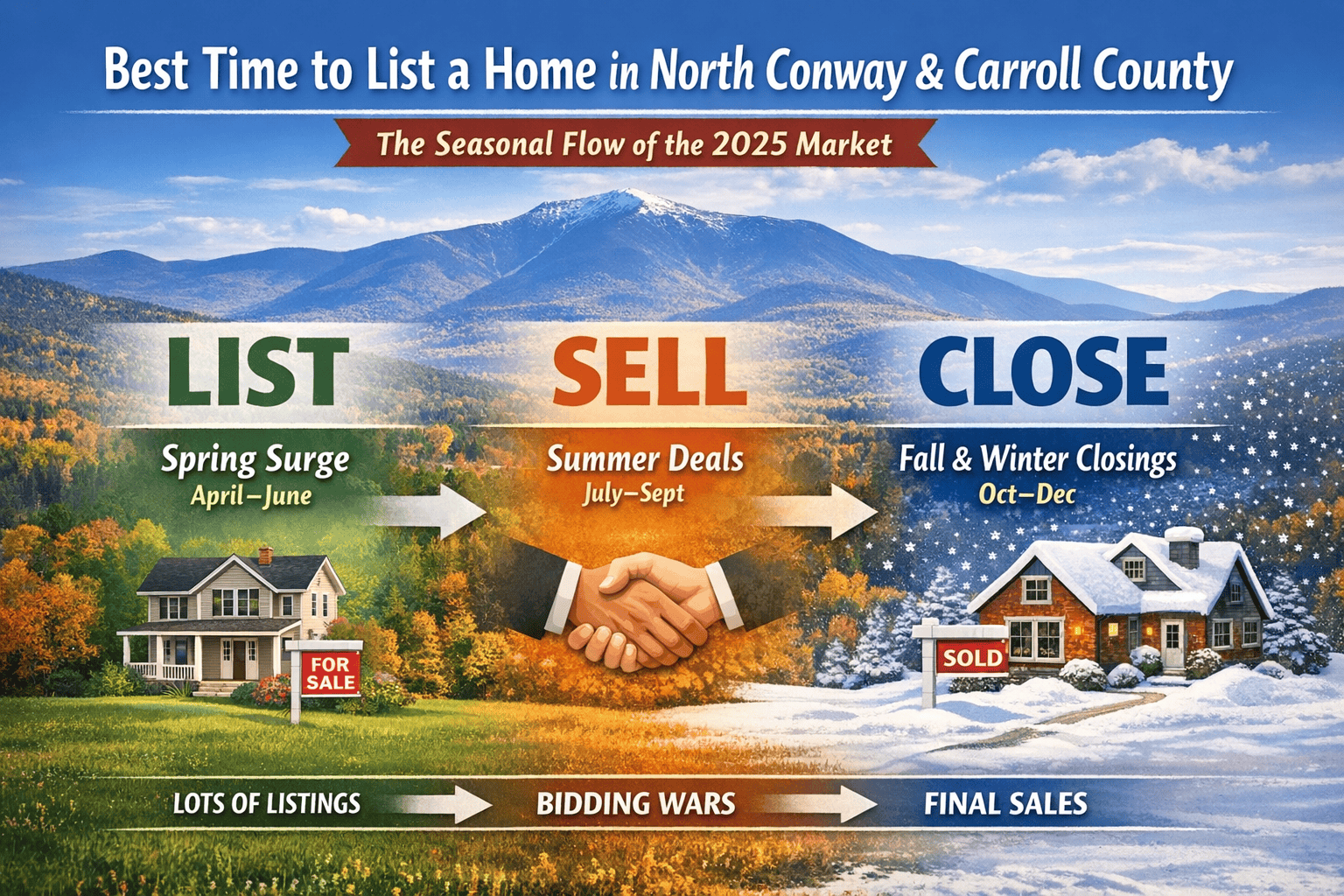
If you’re thinking about buying or selling in Carroll County, timing matters more than most people realize. Looking at 2025 single-family home data, we can clearly see the rhythm of the market — when homes are listed, when they go under contract, and when they finally close.

Let’s break it down by quarter.


When Homes Were Listed in 2025

Quarter New Listings % of Year
Q1 (Jan–Mar) 194 15%
Q2 (Apr–Jun) 465 36%
Q3 (Jul–Sep) 432 34%
Q4 (Oct–Dec) 209 16%

What this shows:
Inventory explodes in late spring and summer.
Nearly 70% of all listings hit the market in Q2 and Q3 alone.

This is when sellers feel most confident and buyers have the most choices.


When Homes Went Under Contract

Quarter Contracts % of Year
Q1 152 17%
Q2 254 28%
Q3 315 35%
Q4 174 19%

Contracts closely follow listings — but with a lag.
The busiest contract period is Q3, even though the most homes are listed in Q2.

That means many homes listed in spring don’t sell instantly — it often takes weeks or months to line up the right buyer.


When Homes Actually Sold

Quarter Closings % of Year
Q1 155 16%
Q2 203 22%
Q3 304 32%
Q4 271 29%

Closings peak later than listings and contracts.
Homes going under contract in summer often close in fall and early winter.


The 3-Step Market Rhythm

Here’s the pattern that jumps off the page:

Stage Peak Quarter
Listings Q2
Contracts Q3
Closings Q3 & Q4

So the real flow looks like:

Spring → list
Summer → negotiate
Fall/Winter → close


What This Means for Sellers

  • Want maximum exposure? List in April–June

  • Want strong contract activity? Expect it in July–September

  • Want to close before winter? Be under contract by late August

Waiting until fall means fewer buyers, fewer showings, and usually more price reductions.


What This Means for Buyers

  • Best selection: Q2 & Q3

  • Less competition: Q4 & Q1

  • Better negotiating leverage: Late fall and winter

But remember — many winter closings were negotiated months earlier.

To make sure 2025 wasn’t just a one-off year, we also analyzed 2018 as a pre-COVID benchmark. What’s striking is how similar the seasonal patterns are. In both years, listings peaked in the spring, contracts surged in the summer, and closings were heaviest in the fall and early winter. Despite very different market conditions and buyer behavior between 2018 and 2025, the overall rhythm of the Carroll County housing market stayed remarkably consistent — showing that this cycle is structural, not situational.


Final Takeaway

The Carroll County single-family market in 2025 followed a clear seasonal cycle:

  • Homes are listed in spring

  • They sell in summer

  • They close in fall and winter

Understanding this timing helps you make smarter moves — whether you’re trying to sell for top dollar or buy with less pressure.

When “Furnishings” Complicate an Easy Real Estate Deal

Here is a lesson that I learn every few years....

You’d think the hardest part of buying or selling a home would be the price, inspection, or financing — but sometimes, it’s the small stuff that causes the biggest mess.
One word in particular: furnishings.

It sounds harmless, but “furnishings” is one of the most subjective and misunderstood terms in real estate. What’s included? What’s not? The answer often depends on who you ask — and what they assume.

The Gray Areas That Cause Trouble

Let’s face it, people get attached to their things. And when you’re talking about a furnished home, it’s not always clear where “personal property” ends and “real property” begins.
Here are a few of the most common items that cause confusion (and sometimes full-blown arguments):

  • Grills: If it’s hooked to a gas line or bolted to the deck, it’s typically considered part of the property. But if it’s a freestanding propane grill? That usually goes with the seller — unless the contract says otherwise.

  • Hot Tubs: A portable plug-in spa can be wheeled onto a trailer in five minutes, while a built-in hot tub might be plumbed, wired, and decked in. Buyers often expect it to stay either way.

  • Artwork & Wall Décor: Mounted artwork, mirrors, or TVs can blur the line between personal décor and fixtures. A TV bracket might be considered a fixture, but the TV itself? Not necessarily.

  • Small Kitchen Appliances: Coffee makers, toasters, air fryers, and blenders often get assumed into a “furnished” home — but they’re personal property. Unless the seller specifically leaves them, they’re not guaranteed.

  • Dishes, Glassware & Cookware: Some buyers expect a fully equipped kitchen if the home is sold “turnkey.” Others assume the seller will be packing up their pots and pans. Without a list, nobody’s wrong — but everyone’s frustrated.

  • Portable Fireplaces or Heaters: Just because it’s providing ambiance doesn’t mean it stays. A freestanding electric fireplace or gas stove is technically portable, while a built-in hearth is part of the home.

  • Patio Furniture & Décor: Outdoor furniture, umbrellas, and planters often fall into a gray zone. They make the home look great during showings, but that doesn’t mean they’re included.

When Emotions Enter the Picture

It’s amazing how quickly a deal can sour over something small. A $400 grill, a set of dishes, or a favorite piece of wall art can become a sticking point that derails a six-figure transaction.
Once emotions get involved — “They promised they’d leave it!” or “That was my grandmother’s mirror!” — even the most cooperative parties can dig in.

The Cure: An Inventory List

If a home is being sold furnished, or even partially furnished, the smartest move is to make an inventory list.
That list should detail every item that’s staying with the property, right down to the lamps and silverware. Buyers should review it carefully and sign off on it before finalizing the deal. Sellers should double-check it before they move out.

Not only does it protect both sides, but it also keeps the focus where it belongs — on the home itself, not the toaster oven.

“Furnishings” might sound simple, but it’s anything but. Whether you’re buying a mountain condo, a lakefront cabin, or a family home, assume nothing.
When in doubt, write it out — because no one wants to see an easy deal unravel over a blender or a missing set of patio chairs.

What's Worth Remodeling Before Selling? Here's What the 2025 Remodeling Impact Report Says

What’s Worth Remodeling Before Selling? Here’s What the 2025 Remodeling Impact Report Says

Every year, the National Association of REALTORS® releases a report on home remodeling—what projects homeowners are tackling, how happy they are with the results, and what kind of return they’re getting if they decide to sell.

The 2025 Remodeling Impact Report just dropped, and there are some great takeaways for anyone considering home improvements—especially if you're thinking about selling in the next few years.

Top Projects with the Best "Joy Score"

This year’s highest “Joy Score”—how happy homeowners feel after completing a project—goes to:

  • Adding a primary bedroom suite

  • Kitchen upgrades

  • New roofing

Each of those scored a perfect 10 out of 10. (Not a shock—who doesn’t love a fresh kitchen or a cozy new suite?)

Which Projects Pay Off the Most?

If you're thinking about ROI (and you should be), here are the top renovations in terms of cost recovery:

  • New steel front door – 100% cost recovery

  • Closet renovation – 83%

  • New fiberglass front door – 80%

  • New vinyl windows – 74%

  • Basement conversion to living space – 71%

These projects give you a big bang for your buck, especially if you're prepping your house for the market.

REALTORS® Say: Do These Before You Sell

According to the agents surveyed, the top things they recommend sellers tackle before listing are:

  1. Paint the entire home

  2. Paint at least one interior room

  3. Replace or repair the roof

Why Are People Remodeling?

Interestingly, many folks aren’t remodeling just because they plan to sell. The top reason? To upgrade worn-out surfaces and finishes. That was followed by improving energy efficiency and simply deciding it was time for a change.

That said, 18% of homeowners remodeled because they were planning to sell within two years—so you’re not alone if that’s your motivation.

Want to Read the Full Report?

If you’re a homeowner in the North Conway area and you're wondering which updates make the most sense for your home, I’ve got the full 2025 Remodeling Impact Report. Just send me a message and I’ll send it over to you. It’s full of great info whether you’re thinking about selling soon, refinancing, or just making your space a little more “you.”

And as always, if you have questions about what buyers are looking for right now in the Mount Washington Valley real estate market, I’m happy to help.

What is radon & why do we test for it during home sales?


What is Radon? A Quick Guide for Home Buyers in New Hampshire & Maine

If you're buying a home in New Hampshire or Maine, you’ve probably heard the term radon tossed around during the inspection process. It’s something that comes up often in our area—and for good reason.

Let’s break down what radon is, why it matters, and how you can handle it if you find high levels in a home you love.


So, What is Radon?

Radon is a naturally occurring radioactive gas that forms when uranium in soil, rock, and water breaks down. It’s colorless, odorless, and tasteless—so you won’t know it's there unless you test for it.

The big concern? Long-term exposure to high levels of radon is the second leading cause of lung cancer in the U.S., right behind smoking. That’s why it’s a serious topic when buying a home.


Why is Radon a Big Deal Around Here?

Radon is common across the country, but parts of New Hampshire and Maine—especially areas with a lot of granite in the ground—tend to have higher levels. I see elevated radon readings come up frequently during home inspections, and it doesn’t mean the house is flawed—it just means it needs a fix.


How Do You Test for Radon?

Testing is simple and affordable. You can go with either:

  • Short-Term Test: Usually takes 2–4 days. This is the most common test during a real estate transaction. It's often done with a charcoal canister or a continuous monitor set up by a home inspector.

  • Long-Term Test: These take 90 days or longer and give a better average over time. These are great for after you move in if you want a fuller picture.

The results are measured in picocuries per liter of air (pCi/L). The EPA recommends fixing radon issues if levels are 4.0 pCi/L or higher.


What Happens if the Radon Levels Are Elevated?

Good news—radon is very fixable.

The most common solution is a radon mitigation system. This usually involves:

  • A PVC pipe system installed in the basement or crawl space.

  • A fan that draws the radon gas from beneath the foundation and vents it safely outside, usually above the roofline.

These systems are typically $1,000–$1,500 and can often be installed in a day. Once installed, they can reduce radon levels by up to 99%.


Should You Walk Away From a Home With Radon?

Not at all. Radon is extremely common, and mitigation systems are straightforward and effective. If you find a home you love, and the radon test comes back high, it’s totally reasonable to ask the seller to install a mitigation system—or to negotiate that into the deal.


Final Thoughts

If you’re house hunting in NH or ME, make sure radon testing is part of your inspection process. It’s one of those behind-the-scenes health and safety items that’s easy to overlook but very important in the long run.

Have questions about radon, home inspections, or anything else as you navigate the buying process? I’m always happy to help.

Dave from North Conway Realty

Comments

  1. Louisville KY Radon Mitigation on

    Excellent post! Radon testing is a crucial part of the home buying process, and this article explains why in a clear and approachable way.
    • Cincinnati Radon Mitigation on

      Thanks for explaining radon testing so clearly! It's good to know why it's important when buying a home.
      • Colorado Springs Radon Mitigation on

        It's a good reminder that radon isn't something you can see or smell, so testing is the only way to be sure your home is safe.

        Understanding the NH Purchase & Sale Agreement

        In NH, we typically use a purchase & sale agreement as the first step of an offer.  That differs from MA where the Letter of Intent or Offer to Purchase start the process.  Here are some of the basics of the NH Purchase & Sale Agreement.  

        Here's an expanded version of each section of the New Hampshire Purchase & Sale Agreement (P&S), along with examples to illustrate how they work in real-life scenarios:


        1. Parties Involved (Section 1)

        This section identifies the buyer and seller, including their names and addresses. Both parties are agreeing to be part of this transaction. For example, John Doe, a buyer, and Sarah Smith, the seller, are entering a legally binding agreement where John will purchase Sarah’s property.


        2. Property Information (Section 2)

        This section specifies the location and legal description of the property being sold. It ensures both parties are on the same page about what is being bought and sold. For example, John is buying a single-family home at 123 Main Street, Conway, NH. The legal description helps avoid any confusion about which property is involved, especially if it shares a lot or boundary with another.


        3. Purchase Price and Deposit (Section 3)

        This outlines the purchase price and earnest money deposit required. It breaks down the timeline for the buyer to submit the deposit, typically held in escrow. For instance, if John agrees to buy Sarah’s house for $350,000, he may provide a $5,000 earnest money deposit to show he’s serious. This deposit is held by the real estate firm until closing.


        4. Deed and Title (Sections 4 and 9)

        This section discusses the type of deed the seller will provide, typically a marketable title free of encumbrances. It also outlines the title examination process. For example, when John buys Sarah’s house, the title company will ensure there are no outstanding liens or claims on the property, like unpaid taxes, before the transaction can be completed.


        5. Transfer of Title and Closing Date (Sections 5 and 6)

        This defines when the title will transfer to the buyer and the agreed-upon closing date. It also confirms that full possession of the property will be transferred to the buyer at closing. John might agree to close on Sarah’s property on December 15th, and by that date, Sarah must vacate the home, leaving it in "broom clean" condition for John.


        6. Representation and Dual Agency (Section 7)

        This section clarifies whether the buyer and seller are each represented by their own agent or if a dual agent represents both. For example, if Sarah’s agent is also representing John in the transaction, both must agree to dual agency to avoid any potential conflicts of interest.


        7. Insurance (Section 8)

        The seller is required to maintain insurance on the property until the sale is finalized. If a fire or flood happens before closing, the insurance payout can either repair the damage or allow the buyer to back out. For example, if Sarah’s house suffers fire damage a week before closing, John could either accept the insurance payout or walk away from the deal and get his deposit back.


        8. Prorations (Section 10)

        This section handles the proration of taxes, utilities, and other property-related costs. It ensures the buyer and seller pay their fair share of expenses up to the closing date. For example, if closing happens halfway through the year, Sarah will pay property taxes for her time in the home, and John will cover the remainder of the year.


        9. Property Inclusions and Disclosures (Sections 11 and 13)

        Here, the agreement specifies what fixtures and personal property are included in the sale, such as appliances or built-in shelving. It also notes the receipt of property disclosures. For example, Sarah agrees to include the refrigerator and washer/dryer in the sale, and John has already reviewed the disclosure about the 10-year-old roof.


        10. Radon, Arsenic, and Lead Paint (Section 12)

        This section explains the risks and testing options for radon gas, arsenic, and lead paint. Buyers are encouraged to test for these hazards. For example, if John is buying an older home, he might order a lead paint test to ensure it’s safe for his young children.


        11. Inspections and Contingencies (Section 14)

        The buyer can conduct various inspections, such as for the home’s condition, pests, water quality, or radon levels. If issues arise, the buyer can negotiate repairs or cancel the deal. For instance, if John’s home inspector finds a leaking roof, John could ask Sarah to repair it before closing or adjust the sale price.


        12. Due Diligence (Section 15)

        The buyer has the right to review any easements, restrictions, or condo documents. If anything is unsatisfactory, they can terminate the agreement. For example, if John learns through due diligence that Sarah’s property is subject to a restrictive covenant prohibiting fences (but John wants to install one), he could back out of the deal.


        13. Financing and Financing Contingency (Section 18)

        This section outlines whether the agreement is contingent on financing, meaning the buyer must secure a loan for the purchase. If John can't obtain a mortgage by a specific date, he can back out of the deal without losing his deposit. However, if John doesn’t inform Sarah in time, he risks forfeiting his deposit.


        14. Wire Fraud Alert

        This section warns about the increasing risk of wire fraud during real estate transactions. For example, before John wires his down payment to Sarah’s escrow agent, he must call the office to verify the bank account details, ensuring it’s not a scam.


        15. Additional Provisions and Addenda (Sections 19 and 20)

        This section includes any extra provisions or addenda that are part of the deal. For example, if John and Sarah agree on additional items like a home warranty or specific repair obligations, they’ll be noted here.


        16. Choice of Law and Venue (Section 21)

        This clarifies that any legal disputes will be governed by New Hampshire law, and any lawsuits will be handled in New Hampshire courts.


        17. Effective Date and Notice (Section 22)

        The effective date is the date when the last party signs the contract and communicates that to the other party. All deadlines in the agreement are counted from this date. For example, if Sarah signs on November 1st and John signs on November 2nd, the effective date is November 2nd, and any deadlines (such as inspection periods or financing) are counted from there.