Blog :: 02-2026

Welcome to the North Conway Realty blog. This is where you’ll find helpful information about buying and selling real estate in North Conway and the surrounding Mount Washington Valley. We share local market updates, tips for buyers and sellers, neighborhood highlights, and insights based on real, current activity—not just headlines. Whether you’re planning a move, watching the market, or simply curious about what’s happening locally, this blog is designed to give you clear, useful information so you can make confident real estate decisions.

New FINCEN Rule for Real Estate (2026): What Buyers, Sellers & Investors Need to Know

What Buyers and Sellers Need to Know About the New FINCEN Real Estate Rule (Effective March 1, 2026)

Starting March 1, 2026, a new federal rule from the Financial Crimes Enforcement Network (FINCEN) will impact certain residential real estate transactions across the country.

If you’ve heard something about “new reporting requirements” or “title companies mailing ownership verification letters,” this is likely what people are referring to.

Here’s what it actually means — and what it doesn’t.


Why This Rule Exists

The new rule is part of a broader federal effort to prevent money laundering in U.S. real estate.

Historically, someone could purchase residential property through an LLC, corporation, or certain types of trusts — often in all-cash transactions — without publicly identifying the real person behind that entity.

FINCEN’s new Residential Real Estate Reporting Rule is designed to increase transparency by identifying the true beneficial owners behind those entity purchases.

In short:
It’s about tracking who is really buying property when it’s not an individual person.


What Transactions Are Affected?

This rule does not apply to every transaction.

It generally applies when all three of the following are true:

  1. The property is residential (1–4 family homes, condos, etc.)

  2. The purchase is non-financed (no traditional bank mortgage involved)

  3. The buyer is a legal entity or certain types of trusts (LLC, corporation, partnership, etc.)

If someone is buying a home in their personal name — even with cash — the rule typically does not apply.

If someone is getting a mortgage through a traditional lender, the rule also generally does not apply because banks already have federal reporting requirements.


Who Has to File the Report?

In most cases, the responsibility falls on the settlement agent or title company — not the real estate agent.

There is a “cascade” system built into the rule, meaning:

  • If there is a settlement agent, they report.

  • If not, it may fall to a title company, escrow agent, or closing attorney.

Real estate agents are not the ones filing the report — but we will likely need to make sure our clients understand the requirements so closing isn’t delayed.


What Information Is Required?

The report will include:

  • The legal name of the entity purchasing the property

  • Information about the beneficial owners (the real people behind the entity)

  • Basic transaction details (price, address, date, etc.)

That may include:

  • Name

  • Date of birth

  • Address

  • Government-issued identification number

For investors who frequently buy through LLCs, this will be the biggest operational change.


What About the “Mailing Requirement” Rumor?

Some people have heard that title companies now have to “physically mail something” to verify ownership.

As of now, there is no broad new national rule specifically requiring physical mail verification for standard land sales.

What is happening, however, is:

  • Title companies are tightening identity verification procedures.

  • Some underwriters may implement mailing verification as an internal anti-fraud measure.

  • Wire fraud prevention practices continue to expand.

That’s separate from the FINCEN reporting rule itself.


What This Means for Buyers

If you’re purchasing through an LLC or trust and paying cash:

  • Expect to provide additional personal documentation.

  • Plan for slightly more paperwork before closing.

  • Don’t wait until the last minute to gather ownership information.

If you’re buying in your personal name with financing, this likely won’t affect you.


What This Means for Sellers

For sellers, there is very little direct impact.

The main consideration is timing.
If a buyer purchasing through an entity fails to provide required information, it could delay closing.

Otherwise, most sellers won’t notice a significant difference.


What This Means for Agents

For agents, this is mostly about awareness and education.

  • Investor clients need to know about this early.

  • Contracts and timelines may need slight adjustments.

  • Communication with the title company becomes even more important.

This rule does not create new federal filing obligations for Realtors themselves — but we should understand it well enough to guide clients through it.


Effective Date

The FINCEN Residential Real Estate Reporting Rule takes effect March 1, 2026.

It applies nationwide — this is a federal rule, not a New Hampshire-specific law.

For most traditional homebuyers and sellers, this will feel like a non-event.

For cash buyers using LLCs or trusts, it introduces more transparency and documentation — but nothing overly complicated if you’re prepared.

As always, the key is simple:

Know the rules early.
Communicate clearly.
Avoid last-minute surprises.

If you’re planning to buy or sell property and have questions about how this might affect your transaction, feel free to reach out. I’m happy to walk you through it.
The 7 Things That Matter Most When Selling Your Home in North Conway and the MWV

Thinking About Selling in the Mount Washington Valley? Here’s What Actually Matters.

If you’re considering selling your home in North Conway, Bartlett, Jackson, Madison, or the surrounding Valley, you’re not just putting a property on the market.

You’re making a financial decision that deserves strategy.

Over the years, many of our sellers have described their experience in similar ways. Instead of telling you what matters most, I’ll let some of them help explain it.

(You can read all of our 5-star reviews here - Zillow | Google)


1. Pricing Is Strategy — Not a Guess

One seller shared:

“He recommended listing our property higher than we initially expected, and it still sold over asking.”

Another said:

“His thoughtful pricing and negotiation strategy led to a highly successful outcome.”

Pricing isn’t about picking a number that “sounds right.”
It’s about understanding:

  • Current sold data (not just active listings)

  • Buyer psychology

  • Inventory timing

  • Leverage

The goal is not simply to get an offer.
The goal is to create positioning that maximizes your net.


2. Presentation Impacts Perception — And Price

Buyers see your home online first. The first impression matters more than ever.

One client wrote:

“He produced beautifully crafted listing materials, including high-resolution photography, professional-grade video walkthroughs, and impressive drone footage that showcased the property’s full potential.”

Another said:

“The presentation he and his photographer created was even better than our Airbnb listing.”

Marketing isn’t just about exposure. It’s about elevation.

Strong visuals:

  • Increase showing requests

  • Build emotional connection

  • Justify value

  • Separate your home from the competition

In a market like the Mount Washington Valley, standing out is not optional.


3. Negotiation Is Where Equity Is Protected

Marketing brings the buyer.
Negotiation protects your money.

Several sellers specifically mentioned this:

“Dave has great negotiation skills, and his advice was on point.”

“He handled the negotiating effectively and the process went very smoothly.”

“He negotiated very well on our sale to get us the best offer possible and quick closing.”

There are multiple negotiation moments in every transaction:

  • Initial offer

  • Inspection responses

  • Appraisal challenges

  • Repair credits

  • Timeline flexibility

Strategic, calm negotiation can be the difference between a deal that works and one that falls apart — or one that quietly costs you money.


4. A Smooth Sale Is Built Behind the Scenes

Many clients describe the process the same way:

“He made the sale of our home effortless and stress free.”

“Communication was excellent! He was with us every step of the way.”

“He kept us informed at every stage, proactively addressed potential issues, and guided us with confidence and clarity.”

Every closing looks smooth in a photo.

But what you don’t see are:

  • Title issues being resolved

  • Challenging negotiations being handled

  • Contract details being explained clearly

  • Inspection concerns being managed

Clear communication and proactive problem-solving create a calm experience — and that’s not accidental.


5. Local Knowledge Isn’t a Bonus — It’s Essential

The Mount Washington Valley is not a generic market.

One client put it this way:

“His knowledge and expertise is unmatched in the Mount Washington Valley.”

Another shared:

“He is very tuned in to the market and we got in on the property as it was going on the market.”

And another:

“He keeps his finger on the pulse of what is going on in the real estate market.”

North Conway behaves differently than Bartlett.
Jackson behaves differently than Madison.
Condo markets behave differently than single-family homes.

Understanding those nuances helps determine:

  • When to list

  • How to price

  • What buyers expect

  • Where leverage exists


6. Integrity and Long-Term Relationships Matter

Real estate isn’t just one transaction. It’s often years — even decades — of trust.

Several clients have worked together repeatedly:

“Dave has been my go-to real estate professional for over 20 years.”

“This is the second time Dave has represented me…”

“After this experience, we truly cannot imagine working with anyone else.”

Another review said something that stuck with me:

“I am confident that his clients’ interests come before his profits.”

That’s the foundation of good representation.


Final Thoughts for Sellers

Selling your home is not just about putting it on the MLS.

It’s about:

  • Strategic pricing

  • Elevated presentation

  • Thoughtful negotiation

  • Clear communication

  • Local expertise

  • Protecting your equity

If you’re considering selling in the Mount Washington Valley and want a conversation about:

  • What your home could realistically command

  • How to position it for maximum leverage

  • What buyers are doing right now

  • What strategy makes sense in today’s market

I’d be happy to talk.

And if you’d like to hear directly from past clients, you can read all of our 5-star reviews here - Zillow | Google

The Seasons in Bartlett NH

If you’re looking for a true four-season condo community in Bartlett, The Seasons at Attitash stands out as one of the most complete resort-style options in the North Conway area.

The Layout & Community

The Seasons is made up of 22 buildings, with 8 units per building. The layout feels organized and cohesive, but not overcrowded. Buildings are spread out nicely, with green space and mountain surroundings that remind you why people love this part of the White Mountains.

Location: Minutes to the Slopes

One of the biggest advantages? You’re just a couple of minutes from Attitash Mountain Resort and Bear Peak.

That proximity makes winter rentals incredibly attractive. Owners and guests can be parked and on the lift in no time. And when the snow melts, you’re still right in the heart of everything — hiking, mountain biking, the Saco River, Story Land, and a short drive into North Conway for shopping and restaurants.

It’s a location that works year-round, not just ski season.

Amenities That Set It Apart

The Seasons isn’t just about condos — it’s about the experience.

Here’s what makes it one of the few true “resort-style” communities in the area:

  • Indoor heated pool

  • Little Fenway wiffle ball field

  • Hot tub

  • Fitness center

  • Arcade / game room

  • Clubhouse space

  • Tennis courts & outdoor recreation areas

That indoor/outdoor pool setup is a big deal in this market. There simply aren’t many condo developments nearby that offer this level of amenities in one place.

For vacation rental guests, that means built-in entertainment regardless of weather. For owners, it adds strong lifestyle value and rental appeal.

On-Site Rental Program

Another major advantage is the on-site rental program. For owners who don’t want to manage bookings, cleaning coordination, or guest communication themselves, having a structured rental option right on property can be a huge plus.

It creates convenience and continuity — especially for out-of-state owners who want income potential without the daily management stress.

Who Is The Seasons Ideal For?

The Seasons works well for:

  • Ski families who want easy access to Attitash

  • Buyers looking for short-term rental potential

  • Owners who want amenities without the price tag of a single-family home

  • People who want a low-maintenance second home

It’s one of the few communities in the North Conway/Bartlett area that truly blends location, amenities, and rental flexibility in one package.


If you’re comparing condos in Bartlett — whether it’s Linderhof, Nordic Village, or other developments — The Seasons deserves a close look. It continues to be one of the more well-rounded resort communities in the valley.

If you’d like to see current availability or talk through how it stacks up as an investment versus personal-use property, just let me know.

Mountain Views and an In-Town Location: Why 16 Purple Finch Road Is Such a Rare Find in North Conway

There are certain properties where the location alone makes them stand out—and 16 Purple Finch Road is one of them. Set in a quiet, tucked-away spot within the Northbrook development, this 3-bedroom, 2-bath condo offers something that’s surprisingly hard to find in North Conway: mountain views, privacy, and true in-town convenience all at the same time. From your private deck, you’re looking directly toward Mount Kearsarge, Hurricane Mountain, and Cranmore.

In the winter, you can see the ski trails lit up across the valley. In the fall, the foliage fills the view. And in every season, the mountains serve as a constant reminder of why people love being here. What makes this location even more appealing is how close you are to everything. Cranmore Mountain is just minutes away, making early morning ski runs easy. Attitash and Wildcat are both within a short drive, giving you access to some of the best skiing and riding in the Mount Washington Valley. If cross-country skiing is more your style, the Mount Washington Valley Ski Touring Center and Whitaker Woods offer miles of groomed trails just a few minutes from your door. Beyond skiing, you’re right in the heart of North Conway. Restaurants, shops, golf courses, hiking trails, and everyday conveniences are all nearby. You can be on the slopes in the morning, back home for lunch, and out to dinner in town without ever feeling like you’ve spent your day driving.

Within the NorthBrook community itself, the setting is peaceful and well-spaced across 46 wooded acres. This particular unit sits in one of the quieter areas, away from traffic, yet still close to the pool, tennis courts, and walking trails. It’s the kind of location that gives you both access and privacy—something buyers consistently value here. Whether you’re looking for a full-time home, a weekend escape, or a place to enjoy the ski season and beyond, 16 Purple Finch Road offers the combination of views, location, and convenience that makes North Conway such a special place to own property. Be sure to watch the video above to get a better sense of the setting, the views, and just how well-positioned this condo really is.

https://northconwayrealty.com/listing/5076454/16-purple-finch-road-conway-nh-03860/

Online Showing Schedulers Are Convenient—But They Also Reveal More Than You Think

Online showing schedulers have become standard in real estate. Tools like ShowingTime and similar platforms make it incredibly easy for agents to book showings, coordinate availability, and avoid the endless back-and-forth of phone calls and texts. From a logistical standpoint, they’re efficient. They save time. They reduce friction. And they help listings get shown faster.

But there’s another side to this that often goes overlooked.

These platforms don’t just help agents schedule showings. In many cases, they also quietly reveal something else: demand.

And demand—or the lack of it—is one of the most powerful negotiation tools in real estate.

What Buyers’ Agents Can See

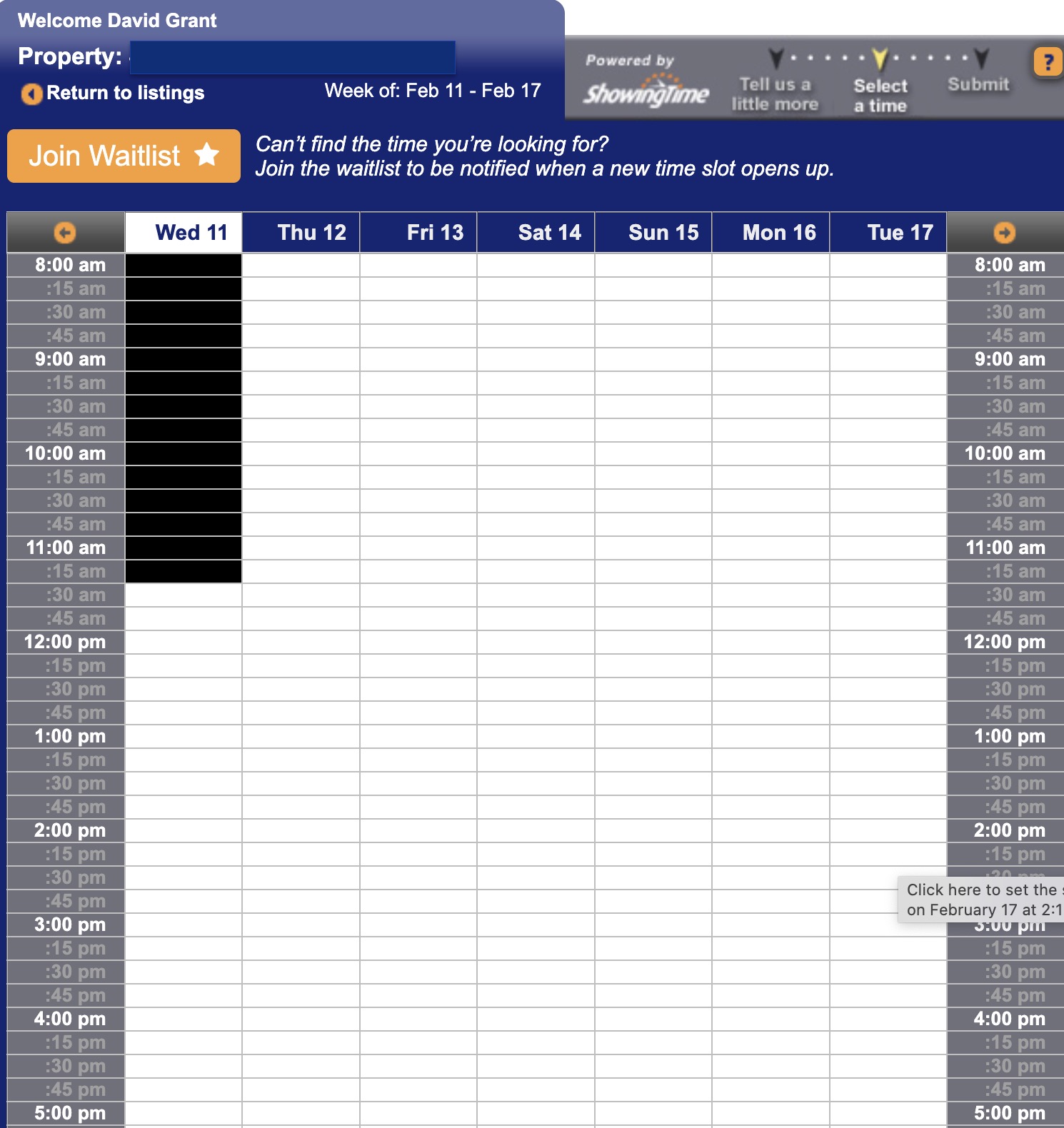
When a showing calendar is visible—even partially—to agents scheduling appointments, it can provide insight beyond just availability. It can tell a story.

If a calendar is filled with blocked time slots, overlapping showings, and limited availability, that signals interest. It suggests competition. It creates urgency.

But when a calendar is wide open for days—or even a full week—that sends a very different message.

It suggests the property may not be seeing much activity.

And that changes how buyers and their agents approach negotiations.

A Real-World Example

I’m currently negotiating on a property for a buyer where the showing calendar is completely open for the next week. There are no showings scheduled. No blocked time slots. No indication of any upcoming activity.

As a buyer’s agent, that information is incredibly valuable.

It tells me:

  • There’s likely no immediate competition.

  • The seller may not have strong leverage at the moment.

  • There’s no urgency to rush or escalate the offer.

  • The buyer may have room to negotiate more aggressively.

This isn’t speculation. It’s simply reading the available data.

If the calendar were full, the strategy would be different. But when it’s empty, it naturally shifts the negotiating position.

Why This Matters for Sellers

Many sellers assume showing activity is private. They believe only their agent knows how much interest their property is receiving.

But in reality, online scheduling tools can indirectly share that information with every agent who attempts to schedule a showing.

That may not matter in the first few days of a listing, when activity is typically strongest. In fact, a busy calendar can actually help reinforce demand and encourage stronger offers.

But if a listing has been on the market for a few weeks and the calendar is empty, that visibility can weaken the seller’s negotiating position.

It gives buyers confidence to push harder.

It removes urgency.

And urgency is often what drives stronger offers.

Convenience vs. Strategy

There’s no question that online scheduling tools are incredibly useful. They make the process smoother for agents, sellers, and buyers alike.

But convenience doesn’t always align perfectly with strategy.

From a listing perspective, controlling the perception of demand is important. Real estate is not just about the physical property—it’s also about positioning.

Perception influences behavior.

Behavior influences offers.

A More Strategic Approach

This doesn’t mean online scheduling tools shouldn’t be used. They absolutely should. But how they’re used matters.

Some more strategic approaches include:

Using approval-based scheduling
Instead of fully open calendars, require confirmation before showings are finalized.

Creating defined showing windows
Group showings into specific time blocks rather than leaving every slot open all week.

Avoiding overly transparent availability
Limiting how much agents can see about open or unused time slots helps maintain negotiating neutrality.

Managing early momentum carefully
The first 7–14 days are critical. Strong early activity creates long-term leverage.

What This Means for Buyers and Sellers

For buyers, tools like this provide insight that can help guide negotiation strategy. It allows them to make informed decisions about timing, pricing, and leverage.

For sellers, it’s a reminder that every part of the listing process—including scheduling—plays a role in positioning the property.

Marketing isn’t just photos and pricing. It’s also about managing information.

The Bottom Line

Online showing schedulers are here to stay, and they provide real benefits. They make the showing process easier, faster, and more organized.

But they also quietly reveal signals about demand.

And in real estate, demand—or the perception of demand—is everything.

Understanding that dynamic allows agents to better protect their sellers’ negotiating position and allows buyers to make smarter decisions.

Like many tools in real estate, it’s not just about using them.

It’s about using them strategically.