
Blog :: 05-2026

Welcome to the North Conway Realty blog. This is where you’ll find helpful information about buying and selling real estate in North Conway and the surrounding Mount Washington Valley. We share local market updates, tips for buyers and sellers, neighborhood highlights, and insights based on real, current activity—not just headlines. Whether you’re planning a move, watching the market, or simply curious about what’s happening locally, this blog is designed to give you clear, useful information so you can make confident real estate decisions.

Please note: The information shared on this blog is intended for general informational purposes only and should not be considered legal, tax, financial, surveying, or professional real estate advice. Real estate laws, regulations, market conditions, and property-specific details can change over time and may vary by situation. Buyers and sellers should consult with qualified professionals regarding their individual circumstances.

How Mini Splits Work in New Hampshire Homes

If you've toured homes in the Mount Washington Valley lately, you've probably noticed them.

Small white boxes mounted high on interior walls. Slim copper lines running along the outside of the house. Sometimes they look sleek. Sometimes they look a little awkward. But they are showing up more and more in homes around North Conway, Bartlett, Jackson, Conway, and the surrounding area.

That’s a mini split.

And if you’re buying or selling in this market, it’s worth understanding what you’re looking at.

The Basic Idea

A mini split is a heating and cooling system.

No ductwork required.

Instead of generating heat the way an oil or propane furnace does, a mini split moves heat from one place to another. In the summer, it pulls heat out of your living space and moves it outside. In the winter, it reverses course and pulls heat from the outdoor air into your home.

Even when it’s cold outside, there is still heat energy in the air. Modern mini splits can extract that heat down to surprisingly low temperatures.

The basic setup is simple from a homeowner’s point of view: one outdoor unit, one or more indoor units, and a small bundle of lines connecting them. Proper sizing and installation still matter a lot, but the system itself is much less invasive than adding ductwork to an older home.

The Two Main Parts

A mini split system has two main components.

The outdoor unit contains the compressor and coil. This is the workhorse of the system. It moves refrigerant through the system and either releases or absorbs heat depending on whether the unit is heating or cooling.

The outdoor unit usually sits on a pad, stand, or wall bracket. It does make some noise, but modern units are much quieter than many people expect.

The indoor unit is the part you see mounted on the wall. It is often called the air handler. It blows conditioned air into the room and pulls room air back through a filter. Most have a small louver that can be adjusted to direct airflow.

These indoor units are typically installed high on a wall, which helps distribute air through the room.

The indoor and outdoor units are connected by what is called a line set. This usually runs through a small hole in the wall and includes refrigerant lines, electrical wiring, and a drain line.

Ducted vs. Ductless

Most older homes in our area were not built with central ductwork.

Adding ductwork can be expensive, disruptive, and sometimes not practical depending on the layout of the house.

Mini splits avoid that issue. Each indoor unit serves a room or zone directly, without ducts.

Multi-zone systems can run several indoor units from one outdoor unit. That means each room or area can have its own temperature control. You can heat the bedroom without heating the living room, or keep one part of the house comfortable while leaving unused rooms set lower.

That can be especially useful in vacation homes and second homes, where the whole house may not be used all the time.

The Heat Pump Part

This is where people sometimes get confused.

A mini split is a heat pump.

It does not burn fuel to create heat. It moves existing heat from one place to another using refrigerant. It is similar to the basic idea behind a refrigerator, just applied to your living space.

That is also why efficiency ratings for mini splits look different from what you might see with an oil, propane, or gas heating system.

Instead of measuring what percentage of fuel gets converted into heat, you are measuring how much heat energy gets moved for each unit of electricity used.

You may see ratings such as COP, which stands for coefficient of performance. Cooling efficiency is often shown as SEER, while heating efficiency may be shown as HSPF or COP.

On a mild day, a good mini split may move three or four units of heat for every one unit of electricity it uses. That is one reason they can be so efficient.

Why Mini Splits Make Sense in New England

Mini splits are a natural fit for a lot of homes in northern New England.

First, many older homes do not have ductwork. A mini split gives those homes a realistic path to efficient heating and cooling without tearing the house apart.

Second, they work well for vacation and second homes. Being able to condition only the rooms you are using can be a real advantage. Many systems also offer remote control through an app, which can let an owner adjust the temperature before arriving.

Third, they are useful for additions and finished spaces. A sunroom, finished basement, garage apartment, or bonus room may not connect easily to the home’s existing heating system. A single-zone mini split can often solve that problem cleanly.

Finally, they can be very efficient. Electricity still costs money, of course, but because a mini split is moving heat rather than creating it by burning fuel on site, a properly installed system can perform very well.

What to Know About Cold Weather Performance

Not all mini splits are the same.

Standard mini splits can struggle when it gets genuinely cold. Older or lower-end units may lose a significant amount of heating capacity when temperatures drop, especially below about 5 degrees Fahrenheit.

Cold-climate mini splits are different. Brands such as Mitsubishi, Daikin, Fujitsu, and Bosch make units designed to perform much better in low temperatures. Some are built to maintain useful heating capacity well below zero.

That matters in the Mount Washington Valley.

If you are looking at a home that relies heavily on mini splits for heat, it is worth asking what brand and model are installed, how many zones serve the home, when the system was installed, and whether there is a backup heat source.

Most buyers in this area do not necessarily think of mini splits as the only heat source. More often, they are part of a layered heating setup along with propane, oil, electric baseboard, a wood stove, or a pellet stove.

In a mountain climate, having more than one practical heat source can be a real advantage.

Maintenance and Practical Considerations

Mini splits are not magic.

They still need maintenance.

Filters should be cleaned regularly. The outdoor unit should be kept clear of leaves, snow, ice, and debris. If performance drops, a qualified professional should check the system. Refrigerant generally should not need to be “topped off” unless there is a leak or another issue.

They also represent a real upfront cost. A single-zone system is one thing. A whole-house multi-zone setup is another. As with most home systems, the quality of the installation matters.

A poorly placed or undersized mini split may not perform the way a buyer expects.

What Buyers Should Ask

When evaluating a home with mini splits, don’t just ask whether the house has them.

Ask better questions:

How many indoor units are there?

What areas of the home do they serve?

Are they used for heating, cooling, or both?

Are they cold-climate units?

When were they installed?

Has the system been serviced?

Is there a backup heat source?

Those questions matter more than simply seeing a white unit on the wall and assuming the house is fully covered.

At the End of the Day

Mini splits have earned their place in New Hampshire homes.

They are efficient, flexible, and increasingly reliable, even in cold climates when the right equipment is installed. They can be especially useful in older homes, vacation homes, additions, and homes where adding ductwork would be difficult or expensive.

They are not the right answer for every house or every buyer. But when you see one in a listing, it is often a sign that the seller invested in the comfort and usability of the home.

If you are looking at a home in the Mount Washington Valley and you are not sure whether the mini split setup is enough for year-round comfort, I’m happy to help you think through the practical real estate side of it.

33 New Listings in 7 Days: Mount Washington Valley Inventory Is Moving

33 Listings in 7 Days: Is This Finally the Opening Buyers Have Been Waiting For?
Here is a link to those listings

If you've been looking for a home in the Mount Washington Valley and feeling like you're always a step behind — you're not imagining it. Inventory has been the story here for years. Not mortgage rates. Not prices. Just not enough homes on the market to give buyers a real shot.

That might be changing.

In the last seven days, 33 new single-family homes and condos have come to market across Conway, Bartlett, Jackson, and Madison. That's a meaningful surge for a market this size.

What low inventory actually felt like

For the past few years, the pattern was predictable. A house would hit the market. Within days, sometimes hours, it had multiple offers. Buyers were waiving inspections, going well over asking, and still losing. Even serious, qualified buyers were burning out after months of near-misses.

The problem wasn't that people couldn't buy. It was that there wasn't enough to buy.

Why this stretch feels different

33 listings in 7 days isn't a normal pace for this market. It suggests sellers who've been waiting are starting to move — whether that's people cashing out of vacation properties, locals downsizing, or owners who've been testing the waters and finally decided to jump.

Whatever the reason, the result for buyers is the same: options.

More listings means you can actually compare. You have time to think. You're not forced into a same-day decision on a property you toured for 20 minutes. That pressure — the pressure that burned so many buyers out — eases when supply picks up.

This isn't a prediction

I'm not calling a market shift or telling anyone prices are about to drop. This is a 7-day window, not a trend declaration. But it is the clearest opening for buyers I've seen in a while, and I think it's worth paying attention to.

If you've been pre-approved and ready but kept hitting empty shelves, right now is a reasonable time to take another look.

What to do next

Pull up what's active in your price range and the towns you care about. If you want a shortcut, send me a message — I can put together a quick rundown of what's new and what's worth a second look.

No long-term contracts. No pressure. Just actual information.

Dave Grant | Broker/Owner, North Conway Realty Serving the Mount Washington Valley since 2001

Beach Access Neighborhoods Around North Conway

There are several beach-access neighborhoods near North Conway.  Here are just a few!


Madison, NH Has More Waterfront Than You Think
Silver LakeMadison, NH Has More Waterfront Than You Think

When people think about buying on the water in the Mount Washington Valley, a few names come up right away. Conway Lake. Ossipee Lake. But Madison, NH quietly holds some of the best waterfront real estate in the region, spread across several very different bodies of water. Here's a quick rundown.

Silver Lake (in the picture)

The headliner. Silver Lake covers 969 acres with a maximum depth of 164 feet and an average depth of 47 feet. It's big enough for powerboats & has a town launch. Properties here range from classic camps to year-round homes, and the demand is consistent. When something comes up on Silver Lake, it moves.

Pea Porridge Pond

Actually three ponds: Big, Middle, and Little. All three sit within the Eidelweiss village district in the northeastern part of Madison. They're popular for kayaking, canoeing, swimming, and fishing, with clear water and forested shorelines. Big Pea Porridge has motor restrictions, no internal combustion engines allowed on the water, which keeps things quiet and the water clean. There's even an active nonprofit preservation association dedicated to protecting the watershed long-term. Eidelweiss is an established community primary and vacation homes. Good place to look if you want a lively neighborhood feel with water access.

Moores Pond

Moores Pond straddles the Tamworth-Madison town line, covers about 43 acres, and is motor-free. Boating is limited to kayaks, canoes, and sailboats, which keeps things calm and quiet. Access is private, coming through two neighborhood communities. On the Madison side, residents of Carved in Bark have their own pond access. Not a place you stumble onto. But if you land in one of those communities, you get a sandy beach on a peaceful pond with mountain views. Hard to beat.

Davis Pond

The one most people drive right past. Small, quiet, tucked back off the main roads. NH Fish and Game stocks it with rainbow trout and brown trout, and it's open year-round. There are private neighborhood beaches on the pond, and the community around it has always kept it well-maintained. No boat ramps with big parking lots. No crowds. Just a locals' pond that's been flying under the radar for a long time.

Madison doesn't have one signature lake. It has several, each with a different vibe and a different price point. If you're open to waterfront living in the Valley, it's worth understanding all of them before you decide what fits.

If you want to talk water access in Madison or anywhere else in the area, give me a call.

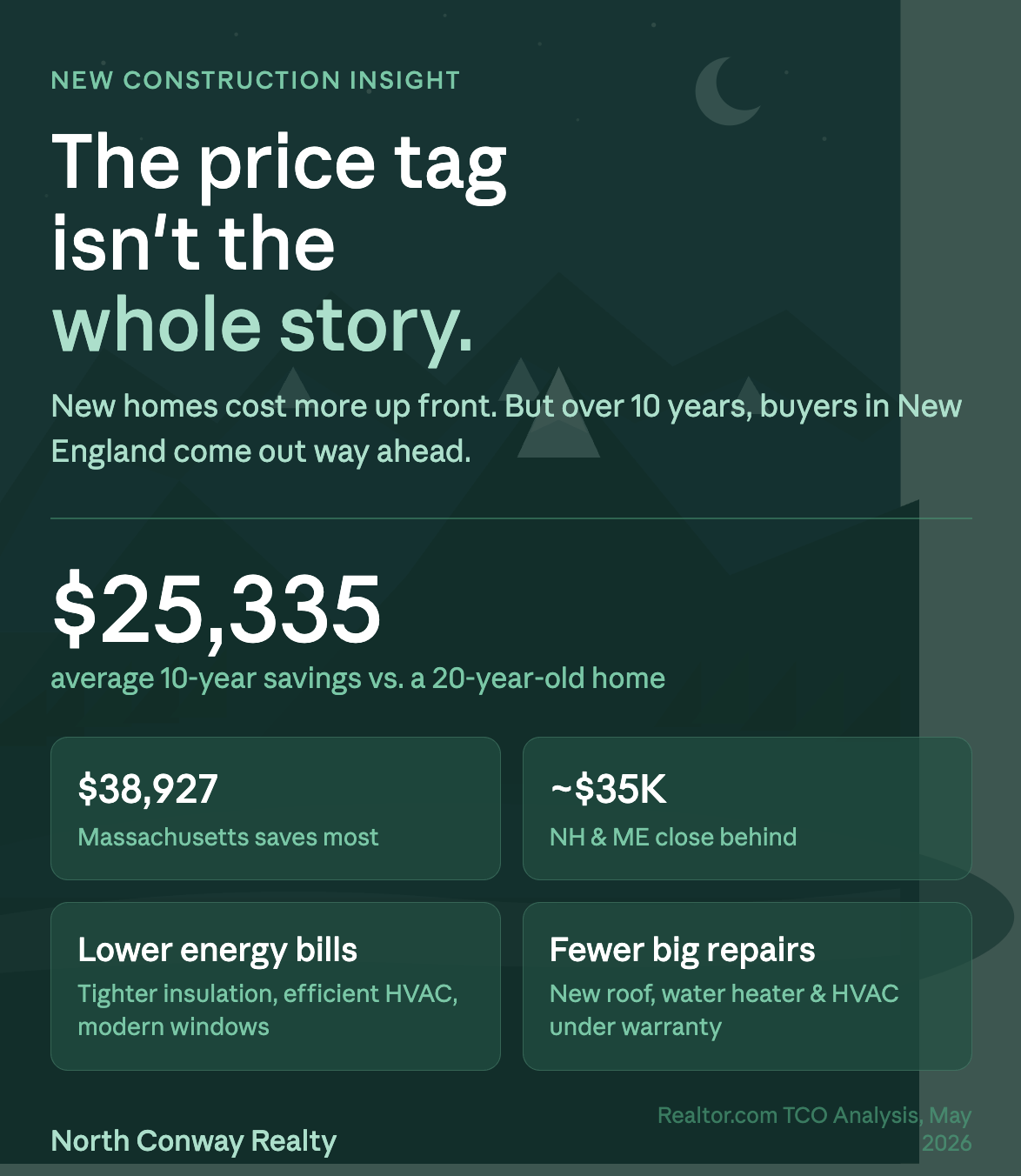
New Homes Cost More. But Do They Really?

The Price Tag Isn't the Whole Story

Everyone looks at the listing price. Makes sense. It's the biggest number on the page.

But a new study from Realtor.com puts a number on something buyers here almost never think about: what a home actually costs to own over time. And the gap is bigger than most people expect. (click here to read the original story)

Buyers of newly built homes save an average of $25,335 over the first ten years of ownership compared to buyers of 20-year-old homes. The savings come from two places: lower energy bills and fewer major repairs.

That's not a rounding error. That's a car payment. A year of tuition. A meaningful chunk of a down payment.

Where the money goes (or doesn't)

The projected savings are tied primarily to lower energy usage and reduced replacement costs for major systems, including HVAC equipment, roofs, and water heaters. A new home has a new furnace. New roof. New windows that actually seal. The older home you're comparing it to? Some of those systems are living on borrowed time.

Newer homes are more likely to come with efficient heating and cooling systems, tighter insulation, better windows, and newer major components, all features that can lower the kinds of expenses that drive up the cost of ownership of older homes.

And here's the thing nobody talks about until it's too late: energy costs in this region are going up, not down. Recent data shows that New Hampshire, Maine, and Vermont all saw double-digit electricity price increases from January to October 2025. Efficiency that saves you money today saves you even more as those bills climb.

New England buyers benefit the most

This isn't a national average story. It's a here story.

New Hampshire and Maine both show high savings, helped by stricter building codes and colder climates that boost efficiency advantages over older homes. Cold winters and modern insulation standards are a powerful combination. New Hampshire comes in at nearly $36,000 in 10-year savings, while Maine comes in around $34,000.

That's not hypothetical. That's the difference between a house that quietly drains your budget every month and one that doesn't.

What this means for buyers in the Valley

Most of the inventory in Carroll County and western Maine is older. Charming, character-rich, sometimes well-maintained. But older. When a buyer tells me they can't justify the premium on a new build, I get it. The sticker price is real.

What's also real: that 2005 Cape with the original boiler and the 15-year-old roof isn't as cheap as it looks. The true cost of ownership is tied to the condition and lifespan of the infrastructure behind the walls.

Run the numbers over ten years. Add up utility bills, the HVAC replacement you'll eventually face, the roof that's got maybe five good years left. The gap between new and existing starts to close fast.

Builder warranties frequently cover HVAC repairs in the early years, meaning new construction buyers often pay nothing out of pocket. Factor in builder incentives on top of that, and the math shifts even further.

So when you are shopping...

Listing price is where the conversation starts. Total cost of ownership is where it should finish.

If you're weighing new construction against resale in the Mount Washington Valley, let's sit down and actually run the comparison. There's no one-size-fits-all answer, but there's almost always a smarter way to look at it.


Source: Realtor.com Total Cost of Ownership Analysis, May 2026

What Is Current Use in New Hampshire? A Guide to Taxes & Land Use

What Is Current Use in New Hampshire? A Plain-English Guide for Buyers and Sellers

If you've spent any time looking at land or rural properties in New Hampshire, you've probably seen the phrase “enrolled in current use” in a listing description. Maybe you nodded along. Maybe you looked it up afterward. Either way, if you're buying or selling property with acreage in the Mount Washington Valley, this is something you genuinely need to understand before you get to the closing table.

Here’s a straightforward breakdown of what current use is, how it works, and why it matters.

The Basic Idea

New Hampshire’s Current Use program (established under RSA 79-A) allows landowners to have their undeveloped land assessed at a much lower value for property tax purposes, based on what the land is actually being used for today rather than what a developer might theoretically pay for it someday.

The goal is simple: make it financially possible for farmers, foresters, and private landowners to hold onto open land without being taxed out of it. And for the most part, it works. Property taxes on current use land can be dramatically lower than on land assessed at full market value.

Who Qualifies?

To enroll in current use, a parcel generally needs to meet a minimum size threshold and fall into one of these categories:

  • Farm land actively used for agricultural production (as little as 1 acre if it meets the criteria)

  • Forest land used for timber growing and harvesting

  • Unproductive land that is neither farmable nor productive forest

  • Wetlands as defined by state standards

  • Land open to public recreational use at no charge may qualify for an additional assessment reduction

For most categories, the minimum is 10 acres, though parcels smaller than that can sometimes qualify if they are contiguous with other enrolled land or meet specific use requirements.

Landowners apply through their local assessing office by April 15th of the tax year. Once enrolled, the land stays in current use as long as it continues to meet the requirements.

What Happens When Land Is Developed or Sold Out of Current Use

This is the part that trips people up, and it’s where real estate transactions can get complicated.

When land enrolled in current use is developed, subdivided, or otherwise converted to a non-qualifying use, a Land Use Change Tax (LUCT) is triggered. The tax is generally calculated as 10% of the fair market value of the land being removed from current use at the time of the change.

That can be a meaningful number. On a parcel where $200,000 worth of land is being removed from current use, you could be looking at a $20,000 tax bill due at the time of the change. In many cases, only the portion of land being removed from current use is subject to the tax.

That liability typically falls on the owner at the time the change occurs, but it’s something buyers absolutely need to factor into their plans and negotiations.

If you're buying land with the intention of building, subdividing, or clearing it, that LUCT is a real cost that belongs in your due diligence calculation right alongside survey fees, perc tests, and road access costs.

A Few Things Buyers Should Know

When you're making an offer on current use land, ask these questions:

  • What is the current use assessment versus the full assessed value?

  • Has any portion of the parcel been released from current use recently?

  • Are there any pending changes that could trigger the LUCT?

  • Is the seller expecting you to absorb the LUCT, or will it be negotiated?

In most transactions I’ve seen, the LUCT question comes up during negotiation. Sometimes the seller handles it as part of the deal. Sometimes it shifts the purchase price. What you don’t want is to be surprised by it at closing.

A Few Things Sellers Should Know

If you're selling land enrolled in current use and the buyer intends to develop it, you'll want to be clear upfront about how the LUCT is being handled. It should be addressed in the purchase and sale agreement, not figured out after the fact.

If the land will remain in current use after the sale, the new owner generally files documentation with the town to continue the enrollment under the new ownership.

The Bigger Picture

Current use is genuinely one of the things that helps keep New Hampshire looking the way it does. A lot of the forests, farms, and open fields you drive past on Route 16 or up through Bartlett and Conway are still intact in part because their owners can afford to hold them without being taxed at the same rate as a subdivision.

For buyers who want land, it’s often a good sign. It often means the land has remained relatively undeveloped or preserved in its natural state. For buyers who want to develop, it’s simply a known cost to plan around.

Either way, now you know what it means.

If you want to dive in to ALL of the details, check out the State of NH Current Use Criteria Booklet

Disclaimer

This article is intended for general informational purposes only and should not be considered legal, tax, or surveying advice. Current Use rules, qualifications, assessments, and Land Use Change Tax calculations can vary based on the property and municipality. Buyers and sellers should consult with the local assessing office, a qualified attorney, tax professional, or land consultant regarding their specific situation.