Real Estate Blog

How Septic System Designs Work in New Hampshire (What Every Home Buyer and Seller Should Know)


Understanding Septic Design in New Hampshire (And Why It Matters for Your Property)

If you’re buying or selling a home in New Hampshire — especially in areas like North Conway, Bartlett, Conway, or anywhere in the Mount Washington Valley — septic systems aren’t just a background detail. They’re a major part of a property’s value, safety, and ability to be used the way you want.

The video featured in this article was created by Caratunk Contractors, a New Hampshire-based excavation and septic system company with decades of experience designing and installing septic systems across the state. Their video does a great job showing what actually goes into a proper septic design — and why it matters so much for real estate.


What Is a Septic Design?

A septic design is the official engineered plan that determines how wastewater will be handled on a property. In New Hampshire, this design must meet state environmental rules and be approved before a building permit can be issued.

It’s not just about where the tank sits — it controls how many bedrooms a home can legally have, where future additions could go, and whether a property can be financed, sold, or improved without expensive surprises.


🔍 How Septic Designs Are Created

Caratunk Contractors walks through the real-world process that happens before a shovel ever goes into the ground.

1. Site Evaluation
The property is physically inspected to understand slopes, wetlands, ledge, drainage, and usable space. Not every lot can support every type of septic system, especially in mountainous or high-water-table areas like much of the Mount Washington Valley.

2. Soil Testing
Test pits are dug so the designer can evaluate how the soil absorbs water and how deep groundwater is. This is one of the biggest factors in determining what type of septic system is allowed.

3. Surveying the Property
A topographical survey is used to map elevations, boundaries, and features. This ensures the septic design will work with the natural layout of the land instead of against it.

4. Creating the Septic Plan
Using all of that data, the designer creates a layout showing the tank, leach field, setbacks from wells and property lines, and system size. This is what determines how many bedrooms the home is approved for.

5. State Approval
The final design is submitted to the state for approval. Only after that approval is granted can the system be installed or a building permit be issued.


🏡 Why This Matters in Real Estate

This process directly affects buyers, sellers, and property values.

For Buyers
The septic design controls how the home can be used. If a house is listed as a three-bedroom but the septic is only approved for two, that can cause serious financing and resale issues. Knowing the design protects you from buying a property that doesn’t match what you think you’re getting.

For Sellers
An approved, up-to-date septic design makes a home much easier to sell. It reduces buyer fear, speeds up financing approvals, and prevents last-minute renegotiations during inspections.

For Renovations and Additions
Want to add a bedroom, finish a basement, or convert a seasonal place into a full-time home? The septic design is often the first thing that determines whether that’s possible.

Caratunk Contractors’ video does an excellent job pulling back the curtain on a process that most homeowners never see — but one that plays a huge role in property value and long-term use.  Here is a link to their website.

If you’re buying or selling a home in New Hampshire, understanding how septic designs work can save you thousands of dollars and months of frustration. And when you’re looking at properties in rural or lake-area towns around North Conway, it’s one of the smartest things you can review early.

If you ever want help tracking down a septic design, understanding what it allows, or figuring out how it affects a home you’re considering, just let me know — I’m happy to help.

Best Time to List a Home in North Conway & Carroll County (2025 Market Timing Guide)

When Do Homes Come on the Market — and When Do They Actually Sell?

2025 Single-Family Homes in Carroll County, NH

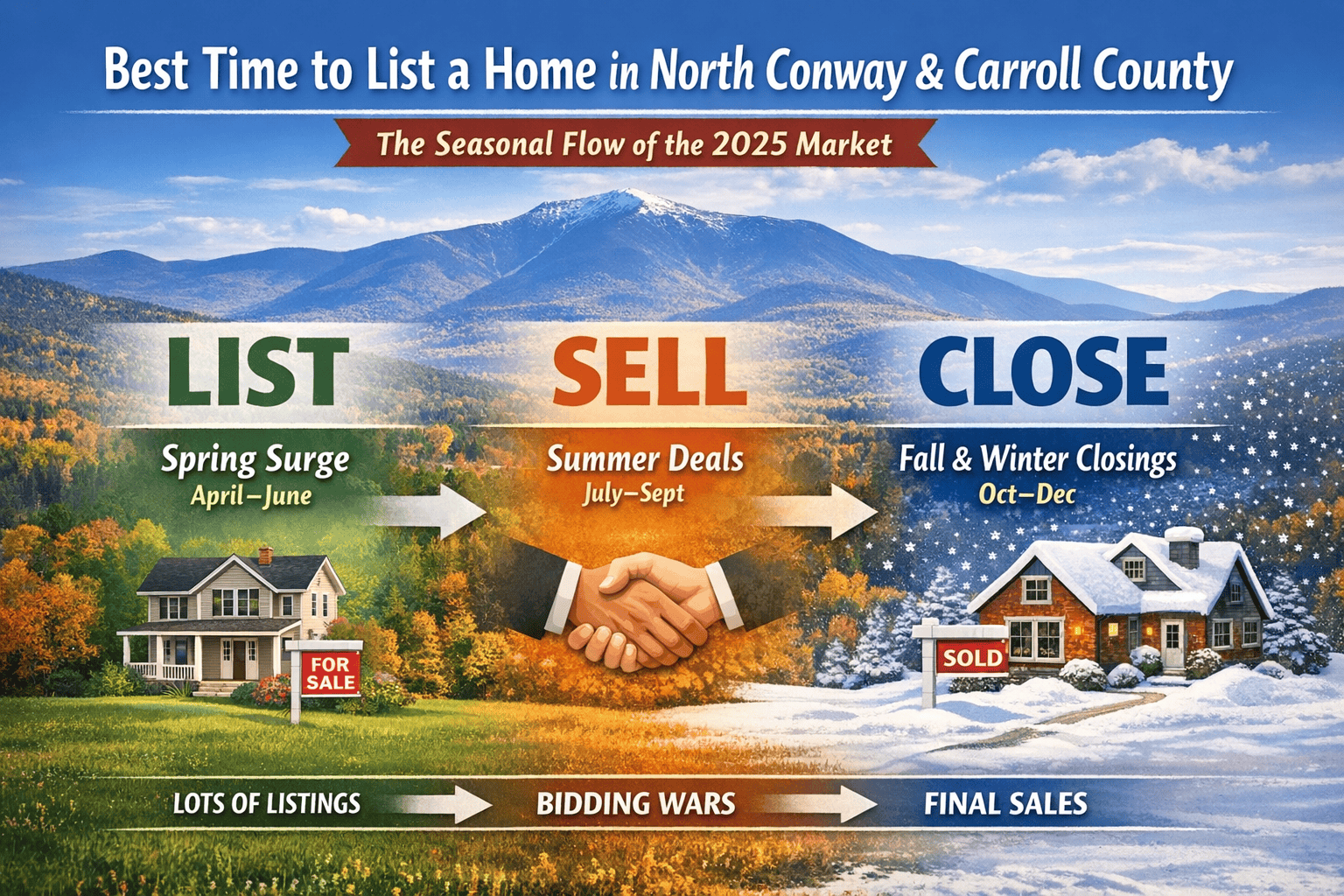
If you’re thinking about buying or selling in Carroll County, timing matters more than most people realize. Looking at 2025 single-family home data, we can clearly see the rhythm of the market — when homes are listed, when they go under contract, and when they finally close.

Let’s break it down by quarter.


When Homes Were Listed in 2025

Quarter New Listings % of Year
Q1 (Jan–Mar) 194 15%
Q2 (Apr–Jun) 465 36%
Q3 (Jul–Sep) 432 34%
Q4 (Oct–Dec) 209 16%

What this shows:
Inventory explodes in late spring and summer.
Nearly 70% of all listings hit the market in Q2 and Q3 alone.

This is when sellers feel most confident and buyers have the most choices.


When Homes Went Under Contract

Quarter Contracts % of Year
Q1 152 17%
Q2 254 28%
Q3 315 35%
Q4 174 19%

Contracts closely follow listings — but with a lag.
The busiest contract period is Q3, even though the most homes are listed in Q2.

That means many homes listed in spring don’t sell instantly — it often takes weeks or months to line up the right buyer.


When Homes Actually Sold

Quarter Closings % of Year
Q1 155 16%
Q2 203 22%
Q3 304 32%
Q4 271 29%

Closings peak later than listings and contracts.
Homes going under contract in summer often close in fall and early winter.


The 3-Step Market Rhythm

Here’s the pattern that jumps off the page:

Stage Peak Quarter
Listings Q2
Contracts Q3
Closings Q3 & Q4

So the real flow looks like:

Spring → list
Summer → negotiate
Fall/Winter → close


What This Means for Sellers

  • Want maximum exposure? List in April–June

  • Want strong contract activity? Expect it in July–September

  • Want to close before winter? Be under contract by late August

Waiting until fall means fewer buyers, fewer showings, and usually more price reductions.


What This Means for Buyers

  • Best selection: Q2 & Q3

  • Less competition: Q4 & Q1

  • Better negotiating leverage: Late fall and winter

But remember — many winter closings were negotiated months earlier.

To make sure 2025 wasn’t just a one-off year, we also analyzed 2018 as a pre-COVID benchmark. What’s striking is how similar the seasonal patterns are. In both years, listings peaked in the spring, contracts surged in the summer, and closings were heaviest in the fall and early winter. Despite very different market conditions and buyer behavior between 2018 and 2025, the overall rhythm of the Carroll County housing market stayed remarkably consistent — showing that this cycle is structural, not situational.


Final Takeaway

The Carroll County single-family market in 2025 followed a clear seasonal cycle:

  • Homes are listed in spring

  • They sell in summer

  • They close in fall and winter

Understanding this timing helps you make smarter moves — whether you’re trying to sell for top dollar or buy with less pressure.

North Conway Home Sales 2024 vs 2025

North Conway Single-Family Home Sales: 2024 vs. 2025 (Zip Code 03860)

If you’re trying to understand where the North Conway single-family home market is headed, comparing last year to this year tells a pretty interesting story. On the surface, prices look fairly stable—but when you dig in, buyer behavior and market dynamics definitely shifted.

Below is a side-by-side look at 2024 vs. 2025 sales in zip code 03860, followed by what it actually means if you’re thinking about buying or selling.

📊 2024 Market Snapshot

  • Total Sales: 40

  • Price Range: $290,000 – $1,200,000

  • Median Sales Price: $528,000

  • Average Sales Price: $551,000

  • Median Days on Market: 12

  • Average Days on Market: 38

  • Cash Sales: 15 (37.5%)

What stood out in 2024:
Homes that were priced right moved quickly. A median of just 12 days on market tells us that well-positioned listings didn’t sit around long, especially in the more desirable neighborhoods. Cash buyers played a big role, making up more than a third of all sales.

📊 2025 Market Snapshot

  • Total Sales: 60

  • Price Range: $275,000 – $1,700,000

  • Median Sales Price: $505,000

  • Average Sales Price: $576,000

  • Median Days on Market: 16

  • Average Days on Market: 43

  • Cash Sales: 18 (30%)

What changed in 2025:
Activity picked up noticeably, with 50% more sales than the year before. The price range expanded on both ends—more entry-level homes sold, but we also saw higher-end transactions pushing the top of the market to $1.7M.

Homes took a bit longer to sell overall, suggesting buyers became more selective and price sensitivity increased.

1. More Sales, Slightly Softer Median Price

Even though the median price dipped from $528,000 to $505,000, the average price rose. That usually means:

  • More lower-priced homes entered the mix

  • High-end sales still performed well

In other words, the market broadened rather than weakened.

2. Homes Are Taking Longer—but Still Moving

Median days on market increased from 12 to 16 days, and average days from 38 to 43. That’s not a slowdown—it’s a normalization. Buyers are taking a bit more time, asking more questions, and being choosier.

3. Cash Is Still King (But Less Dominant)

Cash sales dropped slightly as a percentage:

  • 2024: 37.5%

  • 2025: 30%

Cash buyers are still very much part of the market, but financed buyers are competing more often—especially as inventory improves.

🏡 What This Means for Sellers

  • Pricing strategy matters more than ever

  • Overpriced homes will sit longer than they did in 2024

  • Proper presentation and marketing still lead to strong results

  • There is plenty of buyer demand when the value makes sense

🏠 What This Means for Buyers

  • Slightly more negotiating room than last year

  • More inventory to choose from

  • Still need to be decisive on well-priced homes

  • Cash isn’t required—but strong terms matter

The North Conway single-family home market didn’t cool off—it evolved. More homes sold, price points widened, and the pace became healthier and more balanced.

If you’re thinking about buying, selling, or just want to understand how these numbers apply to your situation, that’s where a hyper-local approach makes all the difference.

Madison, NH Real Estate Market Update: 2024 vs. 2025 YTD

If you’re watching the Madison, New Hampshire real estate market, the big takeaway so far is consistency. When we compare full-year 2024 single-family home sales to 2025 year-to-date activity, Madison is showing a very similar pace, with prices continuing to trend upward while homes take just a bit longer to sell.

2024 Madison Single-Family Home Sales

  • Total sales: 53

  • Median selling price: $399,000

  • Average selling price: $523,000

  • Median days on market: 12

2024 was a strong year for Madison, with quick sales and solid pricing across most segments of the market. Well-priced homes moved fast, and buyer demand stayed steady throughout the year.

2025 Year-to-Date Madison Market Snapshot

  • Total sales: 50

  • Median selling price: $465,000

  • Average selling price: $551,000

  • Median days on market: 21

At nearly the same number of sales as last year, 2025 is tracking closely to 2024 in terms of activity. The most noticeable change is pricing. Both the median and average selling prices are higher, suggesting continued demand and an increasing number of higher-end sales.

Homes are taking a bit longer to sell in 2025, with median days on market rising from 12 to 21. This doesn’t signal a slow market, but it does point to buyers being a little more selective and sellers needing to be more thoughtful with pricing and presentation.

What This Means for Buyers and Sellers in Madison

For sellers:
Madison remains a strong market. Prices are holding — and even improving — but the days of “list it on Friday and accept an offer by Sunday” aren’t guaranteed. Proper pricing, good photos, and a clear strategy matter more than ever.

For buyers:
While prices are higher, the slight increase in days on market can create opportunity. There may be more time to evaluate homes, ask questions, and negotiate terms compared to the ultra-fast pace of previous years.

The Big Picture

Overall, Madison is having a very similar year to 2024, with steady sales volume and rising prices. The market hasn’t shifted dramatically, but it has matured. Balanced expectations on both sides of a transaction are key in 2025.

If you’re thinking about buying or selling in Madison and want to understand how these numbers apply to a specific property or neighborhood, a local, data-driven approach makes all the difference.

Bartlett & Conway Real Estate Market: 2024 vs. 2025 (Jan 1–Nov 30)

Bartlett & Conway Real Estate Market: 2024 vs. 2025 (Jan 1–Nov 30)

Looking at year-over-year numbers is one of the best ways to cut through the noise and see what’s actually happening in our local real estate market. Below is a side-by-side look at single-family home sales in Bartlett and Conway, comparing 2024 to 2025 through November 30.

What stands out most this year is that Bartlett and Conway are telling very different stories.


Bartlett: Strong Demand, Higher Prices, Faster Decisions

Bartlett 2024

  • 52 single-family home sales

  • Price range: $265,000 – $2,350,000

  • Median sale price: $515,000

  • Median days on market: 15

Bartlett 2025

  • 62 single-family home sales

  • Price range: $175,000 – $2,500,000

  • Median sale price: $621,250

  • Median days on market: 12

What changed?

Bartlett saw:

  • More sales (+10 year over year)

  • A significant jump in median price (up over $100,000)

  • Homes selling faster, not slower

This is a clear signal that demand in Bartlett stayed very strong in 2025. Buyers continue to prioritize location, lifestyle, and limited inventory — especially for well-maintained homes and properties that fit the second-home or vacation-rental profile.

For sellers, pricing power remained solid, and buyers were still willing to act quickly when the numbers made sense.


Conway: Higher Activity, But More Price Sensitivity

Conway 2024

  • 123 single-family home sales

  • Price range: $55,000 – $2,400,000

  • Median sale price: $471,000

  • Median days on market: 13

Conway 2025

  • 131 single-family home sales

  • Price range: $65,000 – $1,742,000

  • Median sale price: $465,000

  • Median days on market: 25

What changed?

Conway also posted more total sales, but the direction of the other indicators matters:

  • The median price slipped slightly

  • Median days on market nearly doubled

This suggests a more price-conscious buyer pool in 2025. Homes still sold, but buyers took more time, weighed options, and reacted quickly to properties that felt overpriced.

In short: demand didn’t disappear — it just became more selective.


The Big Picture Takeaway

Even though Bartlett and Conway are neighboring towns, their markets behaved very differently in 2025:

  • Bartlett remained a strong seller’s market with rising values and fast-moving listings

  • Conway shifted toward a more balanced environment where pricing, condition, and presentation mattered more than ever

The biggest risk in 2025 wasn’t listing your home — it was missing the market by starting too high and chasing buyers down later.


What This Means If You’re Buying or Selling

  • Bartlett sellers: Buyers are still out there, but they’re smart. Good pricing and prep are being rewarded quickly.

  • Conway sellers: Strategy matters more than ever. Accurate pricing and strong presentation are key.

  • Buyers: Opportunity exists — especially in Conway — but the best homes still move fast when priced right.

If you’re thinking about buying, selling, or just want to understand how these numbers apply to your specific neighborhood or property, a deeper, property-level conversation usually tells the real story.

When “Furnishings” Complicate an Easy Real Estate Deal

Here is a lesson that I learn every few years....

You’d think the hardest part of buying or selling a home would be the price, inspection, or financing — but sometimes, it’s the small stuff that causes the biggest mess.
One word in particular: furnishings.

It sounds harmless, but “furnishings” is one of the most subjective and misunderstood terms in real estate. What’s included? What’s not? The answer often depends on who you ask — and what they assume.

The Gray Areas That Cause Trouble

Let’s face it, people get attached to their things. And when you’re talking about a furnished home, it’s not always clear where “personal property” ends and “real property” begins.
Here are a few of the most common items that cause confusion (and sometimes full-blown arguments):

  • Grills: If it’s hooked to a gas line or bolted to the deck, it’s typically considered part of the property. But if it’s a freestanding propane grill? That usually goes with the seller — unless the contract says otherwise.

  • Hot Tubs: A portable plug-in spa can be wheeled onto a trailer in five minutes, while a built-in hot tub might be plumbed, wired, and decked in. Buyers often expect it to stay either way.

  • Artwork & Wall Décor: Mounted artwork, mirrors, or TVs can blur the line between personal décor and fixtures. A TV bracket might be considered a fixture, but the TV itself? Not necessarily.

  • Small Kitchen Appliances: Coffee makers, toasters, air fryers, and blenders often get assumed into a “furnished” home — but they’re personal property. Unless the seller specifically leaves them, they’re not guaranteed.

  • Dishes, Glassware & Cookware: Some buyers expect a fully equipped kitchen if the home is sold “turnkey.” Others assume the seller will be packing up their pots and pans. Without a list, nobody’s wrong — but everyone’s frustrated.

  • Portable Fireplaces or Heaters: Just because it’s providing ambiance doesn’t mean it stays. A freestanding electric fireplace or gas stove is technically portable, while a built-in hearth is part of the home.

  • Patio Furniture & Décor: Outdoor furniture, umbrellas, and planters often fall into a gray zone. They make the home look great during showings, but that doesn’t mean they’re included.

When Emotions Enter the Picture

It’s amazing how quickly a deal can sour over something small. A $400 grill, a set of dishes, or a favorite piece of wall art can become a sticking point that derails a six-figure transaction.
Once emotions get involved — “They promised they’d leave it!” or “That was my grandmother’s mirror!” — even the most cooperative parties can dig in.

The Cure: An Inventory List

If a home is being sold furnished, or even partially furnished, the smartest move is to make an inventory list.
That list should detail every item that’s staying with the property, right down to the lamps and silverware. Buyers should review it carefully and sign off on it before finalizing the deal. Sellers should double-check it before they move out.

Not only does it protect both sides, but it also keeps the focus where it belongs — on the home itself, not the toaster oven.

“Furnishings” might sound simple, but it’s anything but. Whether you’re buying a mountain condo, a lakefront cabin, or a family home, assume nothing.
When in doubt, write it out — because no one wants to see an easy deal unravel over a blender or a missing set of patio chairs.

Welcome to 45 Intervale Lane, Bartlett, NH — A Classic Mountain Getaway


Welcome to 45 Intervale Lane, Bartlett, NH — A Classic Mountain Getaway

Tucked along a quiet side street in Bartlett, this charming and fully updated mountain home offers the perfect blend of comfort, character, and location. Whether you’re chasing first tracks at Attitash, hiking Cathedral Ledge, or strolling through North Conway Village, this is the kind of place you’ll love coming home to.

Step inside to a bright and cozy living room featuring a wood stove, large new windows, and that unmistakable New Hampshire cabin-style warmth. It’s the perfect spot to unwind after a day outdoors — boots drying by the fire, favorite drink in hand.

The kitchen has been completely refreshed with new stainless-steel appliances, updated lighting, flooring, and fresh paint. Just off the kitchen, a sunny breakfast nook and a wood-accented sunroom provide two inviting spaces to sip your morning coffee or catch up with friends.

Upstairs, you’ll find two comfortable bedrooms, a full bath, and a bonus room that could easily flex into an office, guest area, or playroom. There’s even additional unfinished attic space ready for storage or future expansion.

Outside, the .42-acre lot is level and private, complete with two storage buildings and that true New England touch — the Conway Scenic Railroad running just beyond the property line. And only 2,000 feet away, you’ll find a private association beach on the Saco River, perfect for swimming, or relaxing in the sun.

Nearly everything has been improved in the past few years — new windows, fresh paint inside and out, new flooring, bathroom updates, and a new water heater. The full basement offers incredible storage for skis, kayaks, and all your White Mountain gear.


A Four-Season Bartlett Favorite

Fall brings incredible foliage and easy access to nearby trails like Diana’s Baths, Echo Lake, and the Kancamagus Highway. In winter, you’re just minutes from Attitash, Cranmore, and Wildcat, with Bretton Woods a short drive away. Spring and summer mean tubing, kayaking, and swimming on the Saco — all practically in your backyard.

Whether you’re looking for a year-round home, a weekend getaway, or a vacation rental with unbeatable location, 45 Intervale Lane delivers mountain living at its best.

https://northconwayrealty.com/listing/5067890/45-intervale-lane-bartlett-nh-03845/

Why Some New Hampshire Condos Don't Qualify for Conventional Financing

Some condos in New Hampshire can look great on paper but still be ineligible for conventional financing. This is especially common in resort towns like North Conway, Bartlett, or Lincoln, where many condo complexes are structured more like hotels than traditional residential buildings.

One of the most common examples is condos with on-site rental management. These properties often have a central front desk, daily or weekly rentals, and housekeeping services—essentially functioning like a condotel. Because they operate more like a hotel, Fannie Mae and Freddie Mac classify them as higher risk and won’t back conventional loans on them. Buyers for these properties usually need to pay cash or use a portfolio or commercial loan, which often comes with higher rates and larger down payments.

Another situation that raises a red flag is when one person or company owns too many units in the complex. If a single entity owns more than 25% of the total units, most lenders won’t approve conventional financing. This is because if that owner stops paying association fees or influences management decisions, it could impact the financial health of the entire association.

New or incomplete developments can also be an issue. If the project is still under construction or the developer hasn’t handed over control to the condo association, conventional lenders generally won’t approve financing until it’s considered “complete” and “warrantable.”

Lenders also look at owner-occupancy ratios. If too many units are rented out—especially for short-term or Airbnb-style stays—it can push the project into “non-warrantable” territory. Most lenders want at least half the units to be owner-occupied before offering conventional loans.

Finally, financial or legal issues within the condo association can disqualify a property. If the association has large unpaid fees, pending lawsuits, or low reserve funds, lenders may see it as too risky.

If you love a condo that doesn’t qualify for conventional financing, there are still options. Local banks may offer portfolio loans, some lenders might approve financing with a larger down payment, or you could consider a cash purchase if it makes sense for your goals.

The bottom line is that not all condos are treated equally when it comes to financing. In the Mount Washington Valley area, where many properties serve as both vacation homes and short-term rentals, it’s especially important to work with an agent and lender who understand how these unique setups affect loan eligibility. Sometimes, a “cash only” listing isn’t a dead end—it’s just a different kind of opportunity.

The Hard Truth About North Conway Vacation Rentals

Why Most North Conway Rentals Don’t Cash Flow

This is not going to be a popular opinion—but I’d rather be honest up front.

A lot of buyers come into the North Conway market thinking they can buy a vacation home, finance 80% of it, and let rental income cover the mortgage and expenses. While it sounds like the perfect plan, the reality is that in 95% of cases, the numbers simply don’t work out that way.

Looking at the Numbers

Here are real projections from recent local properties:

  • $400,000 home: With a mortgage, taxes, utilities, and fees, annual expenses are about $36,000. At average occupancy (around 40%), it brings in $27,000 in rent. That’s a $9,000 shortfall each year

  • $570,000 home: Expenses run over $45,000. Rental income ranges from $28,000 to $38,000, leaving you $7,000–$16,000 in the red most years

  • $465,000 condo: Annual expenses top $41,000. Rental income comes in between $23,000 and $33,000, meaning you’re still losing money in almost every scenario

Only in the absolute best-case situations (high occupancy and high nightly rates) do these properties even approach break-even—and that doesn’t account for repairs or unexpected costs.

Why They Don’t Work as Cash Flow Properties

There are a few simple reasons why these homes rarely cash flow:

  • Occupancy averages just 40%. Yes, it’s busy on ski weekends and during foliage season, but there are plenty of slow months.

  • The market is saturated. With hundreds of rentals to choose from, guests shop by price, keeping revenue in check.

  • Expenses are higher than expected. Heating, HOA fees, internet, management companies, and utilities add up fast.

A Better Way to Think About It

Buying a rental property in North Conway makes sense if you approach it as a lifestyle investment, not a pure income property. It works best for buyers who want:

  • A vacation home they’ll enjoy personally,

  • Supplemental income to offset taxes, utilities, and upgrades,

  • Long-term appreciation instead of immediate cash flow.

If you’re looking for a property that pays for itself and puts money in your pocket every month, this market probably isn’t for you. But if you want a place to enjoy that helps offset its own costs, it can be a great decision.

North Conway rentals aren’t “get-rich” properties. They’re vacation homes first, with the benefit of rental income to soften the financial load. Go in with the right expectations, and you’ll love owning here. Go in expecting cash flow, and you’ll likely be disappointed.

The Small Upgrade That Can Save You Big Headaches: Septic Tank Risers

Why Every Homeowner Should Invest in a Septic Tank Riser

If you own a home in New Hampshire, you already know: winter can be brutal. When the snow piles up to three feet deep and the ground is frozen solid, the last thing you want to deal with is trying to locate and dig out your septic tank lid. But if something goes wrong—or even if you just need routine maintenance—finding and accessing your tank in the middle of February can turn into a costly and stressful ordeal.

That’s where a septic tank riser comes in.

What Is a Septic Tank Riser?

A riser is simply an extension that brings the access lid of your septic tank up to ground level. Instead of being buried under dirt, rocks, or feet of snow, your tank can be reached quickly and easily with no digging required.

Why It’s Worth the Investment

  • Snow and frozen ground aren’t a problem. Imagine trying to dig through frozen soil in single-digit weather. Without a riser, that’s your reality if your tank needs attention in the winter.

  • Emergency access. Septic issues rarely happen at “convenient” times. A riser ensures you (or your service provider) can get to the tank right away, without waiting for a thaw.

  • Peace of mind. For a few hundred dollars, you gain the comfort of knowing that if a problem ever comes up, you’re prepared. It’s one of those small upgrades that pays for itself the very first time you need it.

  • Easier maintenance. Pumping and inspections become faster and cheaper since the tank is always accessible.

Think of It Like Insurance

A riser is the kind of investment you hope you won’t need to use often. But the one time you do? It more than covers its cost. When you picture someone outside in January trying to chip away at the frozen ground just to locate your septic tank lid—you’ll be glad you spent the money.

If you don’t already have a septic riser, consider adding one before the snow flies this year. For most homeowners, it’s a small project with a huge payoff: less stress, lower costs, and the ability to sleep easy knowing that your septic system is accessible any time of year.

50% of homes around North Conway had a price cut!

Half of Homes on the Market Are Seeing Price Adjustments

If you’ve been following the real estate market in the Mount Washington Valley, you’ve probably noticed that things are shifting. We recently looked at 138 homes for sale across Bartlett, Conway, Freedom, Madison, Jackson, and Tamworth. One key takeaway jumped out:

👉 50% of all active listings have already seen at least one price adjustment.

That’s a big number — half of the sellers out there have had to revisit their asking price. But when you dig into the details, some clear trends start to emerge.

Price Range Matters

Not all price points are created equal when it comes to adjustments. Here’s what we’re seeing:

  • $400k–$600k homes: Roughly 64% have dropped in price.

  • $600k–$800k homes: About 56% have adjusted.

  • $800k–$1M homes: The highest rate, with nearly 78% seeing price reductions.

  • Under $400k: Less than 40% have adjusted.

  • $1M+: Surprisingly, only about 29% have reduced their price.

📊 In other words, mid-to-upper priced homes are the most likely to face cuts, while entry-level properties and ultra-luxury listings are holding steadier.

Town-by-Town Trends

The town you’re shopping (or selling) in also plays a role:

  • Jackson: Stands out with two-thirds of listings having reduced their price.

  • Tamworth: Close behind, with 60% showing adjustments.

  • Conway & Madison: Right around the 50% mark.

  • Bartlett: The lowest rate, at 41%.

This tells us that buyers in Jackson and Tamworth are seeing more negotiating room, while sellers in Bartlett are finding a bit more stability.

What This Means for Buyers and Sellers

  • Buyers: The numbers suggest opportunities, especially in the mid-price ranges. If you’ve had your eye on something between $400k and $1M, chances are it’s already been adjusted — and sellers may still be flexible.

  • Sellers: Pricing right from the start matters more than ever. Homes that overshoot the market are finding themselves dropping back down, sometimes more than once.

The Bottom Line

Half of the homes currently on the market in Bartlett, Conway, Freedom, Madison, Jackson, and Tamworth have already seen price changes. If you’re thinking about buying, now’s a good time to look closely at the adjusted listings. If you’re selling, keep in mind that today’s buyers are paying attention — and they’re quick to notice when a property lingers on the market.

What has sold in the last 6 months?

Market Snapshot: What's Happening in the North Conway Realty Area?

Welcome to our latest market update! As we dive into the data from the last 175 home sales in Bartlett, Conway, Freedom, Madison, Jackson and Tamworth, we've uncovered some fascinating trends that are shaping the real estate landscape in our region. Whether you're a buyer, seller, or just a curious local, these insights can help you better understand the market.

Key Takeaways: Speed and Price Adjustments

The overall market is moving quickly, with homes spending an average of just 42.15 days on the market before being sold. The median DOM is even faster at only 17 days, indicating that many homes are selling very soon after listing. This speed is partly fueled by a strong cash buyer presence, with 37.71% of all sales being cash transactions.

Interestingly, 50 of the sold homes had at least one price change before they were purchased. This suggests that while the market is active, pricing your home correctly from the start is still a crucial factor.  For homes currently on the market, almost 50% have had at least one price adjustment.

What Makes a "Hot Home"?

For homes that sold in 17 days or less, we identified some common traits. These fast-selling properties, or "hot homes," were characterized by:

  • An average of 1,823 square feet of living space (median 1,644 sq ft).

  • An average of 2.8 bedrooms (median 3).

  • The most common price range was $250,000 - $500,000, which accounted for 46 of the fastest sales.

Local Market Breakdown by Town

The market performance varied significantly by town. Here's a look at the number of homes sold, median list price, and median close price in our key areas:

Town Number of Sales Median List Price Median Close Price
Conway 74 $490,000 $480,000
Bartlett 35 $625,000 $620,000
Madison 27 $459,900 $465,000
Tamworth 21 $349,900 $355,000
Freedom 10 $561,500 $542,000
Jackson 8 $771,950 $745,000

As you can see, Conway had the highest volume of sales, while Jackson commanded the highest median prices. The Days on Market also varied by price range, with homes in the $750,000 - $1 million range having the longest average DOM at 71.91 days, while those under $250,000 were the fastest-selling with an average DOM of just 12.43 days.

The local real estate market is dynamic and robust. Homes are selling quickly, and while cash buyers are a significant presence, a well-informed pricing strategy is key to a successful sale. For more personalized insights on your specific property or to discuss your real estate goals, don't hesitate to reach out to a North Conway Realty agent today!

Carroll County Real Estate: 2025 vs. Pre-COVID 2019

We often hear people talk about wanting to return to a “normal” real estate market — like the one we had before COVID hit. But how does today’s market actually stack up against 2019? Let’s look at the first five months of each year and see what’s really changed.

Category 2019 (YTD)        2025 (YTD)       % Change
Homes Listed  614 498 -18.9%
Homes Under Contract       237 229 -3.4%
Homes Closed 332 287 -13.6%
Median Sold Price $277,250 $489,000 +76.4%
Median Days on Market 57 25 -56.1%

What These Numbers Tell Us

  • Listings Are Down: Inventory is still tight compared to 2019, with nearly 19% fewer homes listed so far in 2025.

  • Demand Remains Strong: The number of homes going under contract is only slightly down (3.4%) despite fewer listings — showing buyer interest is holding steady.

  • Fewer Closings: Closed sales are down about 13.6%, but that’s not surprising given the limited inventory.

  • Prices Have Soared: The median sold price jumped from $277,250 in 2019 to $489,000 in 2025 — a 76% increase. Home values have nearly doubled in six years.

  • Homes Sell Faster: Median days on market have been slashed by more than half — from 57 days in 2019 to just 25 days today. Well-priced homes are moving quickly, even in a more “normal” environment.

The Big Picture

Compared to pre-COVID days, Carroll County’s market is very different:

  • There are fewer homes for sale.

  • Prices are dramatically higher.

  • Homes are selling much faster.

While some signs suggest a bit of normalization — like more price adjustments and buyers being slightly more selective — the market hasn’t returned to 2019 conditions. If anything, we’ve entered a new era where inventory remains tight and prices reflect the high demand and limited supply that have defined the past several years.

Carroll County Real Estate: What It Feels Like vs. What's Really Happening

If you’ve been paying attention to the Carroll County real estate market this spring, it feels like the market is cooling down — more homes are hitting the market, price reductions are becoming more common, and buyers seem to be taking a little more time.

But when we dig into the actual numbers from January 1st through June 1st, the reality tells a different story.

Category 2024 (YTD)        2025 (YTD)          % Change
Homes Listed 370 498 +34.6%
Homes Under Contract                       162 229 +41.4%
Homes Closed 230 287 +24.8%
Median Days on Market 26 25 -3.8%
Median List Price $469,900 $499,000 +6.2%
Median Sold Price $460,000 $489,000 +6.3%

What It Feels Like:

  • More homes for sale and more price reductions make it seem like sellers are struggling.

  • Buyers are seeing more options, which can create the sense that they have the upper hand.

  • Overall, it feels like the market is slowing down compared to the red-hot years we’ve just come through.

What’s Really Happening:

  • Inventory is up — listings have increased by 34.6%, giving buyers more choices, but demand is also keeping up.

  • Buyer activity is strong — homes under contract jumped 41.4% compared to last year.

  • Sales are up — closed transactions rose 24.8%, meaning homes are still selling at a strong pace.

  • Homes are selling slightly faster — median days on market dropped from 26 to 25 days.

  • Prices are rising — median sold prices are up 6.3% year-over-year.

Big Picture:

Yes, there’s more inventory, and yes, some sellers are adjusting expectations — but the fundamentals are still strong. Homes are selling faster, and prices are higher than they were a year ago. It’s not the frantic market of a couple of years ago, but it’s still very healthy.

Bottom Line:
While it feels like a shift, the reality is that Carroll County’s real estate market is holding steady and even showing signs of growth.

If you’re thinking about buying or selling, understanding the data behind the feeling can give you a real advantage.

Is backwashing killing your septic system?

Is Your Water Softener Hurting Your Septic System?

Here’s What You Need to Know If you have a septic system, chances are you’re careful about what goes down your drains. You know the basics — no grease, no wipes, no harsh chemicals. But there’s one thing many homeowners don’t think about: their water softener. Water softeners are great for preventing hard water build-up, protecting your pipes, and extending the life of appliances. But here’s the catch: many water softeners use a process called backwashing to clean themselves. This involves flushing a salty brine solution through the system — and if that salty water is draining into your septic system, it could be doing more harm than good.

Why Is Backwash Water a Problem for Septic Systems?

  • Salt kills beneficial bacteria Your septic system relies on natural bacteria to break down waste. High concentrations of salt can kill off those good bacteria, making your system less effective and increasing the risk of clogs and backups.
  • It can damage your drain field Over time, too much salt can damage the soil structure in your drain field. That can lead to pooling, slow drainage, and eventually — very costly repairs or replacement.
  • Increased water load Water softeners can discharge large volumes of water during backwash cycles, putting extra strain on your septic system. Septic systems are designed to handle a certain flow; overwhelming them can lead to system failure faster than you think.

What Can You Do About It?

If you have both a septic system and a water softener, don’t panic — but do take a closer look at your setup.

✅ Check if your water softener is septic-safe Some modern systems are designed to minimize salt and water use, making them much more septic-friendly.

✅ Consider rerouting In some homes, the water softener’s discharge can be routed separately so it bypasses the septic system altogether.

✅ Talk to a pro If you’re not sure how your system is set up, it’s worth having a plumber or septic specialist take a look. A little prevention now could save you tens of thousands later. Bottom Line: Water softeners are great — but if you have a septic system, you need to make sure the two are working together, not against each other. Protect your home, your system, and your wallet by making sure your softener is properly set up.

Want a quick breakdown? Check out the video I just posted — it explains everything in under a minute!

16-30 of 145 Posts